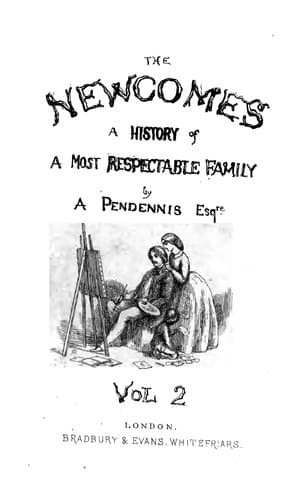
The Newcomes: Memoirs of a Most Respectable FamilyThackeray, William Makepeace
General
The Newcomes: Memoirs of a Most Respectable Family
Thackeray, William Makepeace
Domestic fiction; Families -- England -- Fiction
When this little party has gone out smiling to take its walk on the
sea-shore, the Colonel sits down and resumes the interrupted dessert.
Miss Honeyman talks of the children and their mother, and the merits of
Mr. Kuhn, and the beauty of Miss Ethel, glancing significantly towards
Clive, who has had enough of gingerbread nuts and dessert and wine, and
whose youthful nose is by this time at the window. What kind-hearted
woman, young or old, does not love match-making?
The Colonel, without lifting his eyes from the table, says “she reminds
him of—of somebody he knew once.”
“Indeed?” cries Miss Honeyman, and thinks Emma must have altered very
much after going to India, for she had fair hair, and white eyelashes,
and not a pretty foot certainly—but, my dear good lady, the Colonel is
not thinking of the late Mrs. Casey.
He has taken a fitting quantity of the Madeira, the artless greeting of
the people here, young and old, has warmed his heart, and he goes
upstairs to pay a visit to his sister-in-law, to whom he makes his most
courteous bow as becomes a lady of her rank. Ethel takes her place
quite naturally beside him during his visit. Where did he learn those
fine manners which all of us who knew him admired in him? He had a
natural simplicity, an habitual practice of kind and generous thoughts;
a pure mind, and therefore above hypocrisy and affectation—perhaps
those French people with whom he had been intimate in early life had
imparted to him some of the traditional graces of their _vieille
tour_—certainly his half-brothers had inherited none such. “What is
this that Barnes has written about his uncle, that the Colonel is
ridiculous?” Lady Anne said to her daughter that night. “Your uncle is
adorable. I have never seen a more perfect grand Seigneur. He puts me
in mind of my grandfather, though grandpapa’s grand manner was more
artificial, and his voice spoiled by snuff. See the Colonel. He smokes
round the garden, but with what perfect grace! This is the man Uncle
Hobson, and your poor dear papa, have represented to us as a species of
bear! Mr. Newcome, who has himself the ton of a waiter! The Colonel is
perfect. What can Barnes mean by ridiculing him? I wish Barnes had such
a distinguished air; but he is like his poor dear papa. _Que
voulez-vous_, my love? The Newcomes are honourable: the Newcomes are
wealthy: but distinguished—no. I never deluded myself with that notion
when I married your poor dear papa. At once I pronounce Colonel Newcome
a person to be in every way distinguished by us. On our return to
London I shall present him to all our family: poor good man! let him
see that his family have some presentable relations besides those whom
he will meet at Mrs. Newcome’s, in Bryanstone Square. You must go to
Bryanstone Square immediately we return to London. You must ask your
cousins and their governess, and we will give them a little party. Mrs.
Newcome is insupportable, but we must never forsake our relatives,
Ethel.
Public-domain text, read in full here on John Shaqi.
Reviews
Reviews
No reviews yet
Be the first to share your thoughts on this work.
Elsewhere in the archive
Join the Discussion
Join the discussion
Sign in to leave a comment or review.
Sign InorCreate an account