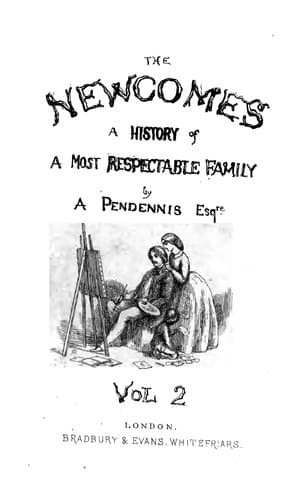
The Newcomes: Memoirs of a Most Respectable FamilyThackeray, William Makepeace
General
The Newcomes: Memoirs of a Most Respectable Family
Thackeray, William Makepeace
Domestic fiction; Families -- England -- Fiction
The time is not very long since, though to-day is so changed. As we
think of it, the kind familiar faces rise up, and we hear the pleasant
voices and singing. There are they met, the honest hearty companions.
In the days when the Haunt was a haunt, stage-coaches were not yet
quite over. Casinos were not invented: clubs were rather rare luxuries:
there were sanded floors, triangular sawdust-boxes, pipes, and tavern
parlours. Young Smith and Brown, from the Temple, did not go from
chambers to dine at the Polyanthus, or the Megatherium, off potage à la
Bisque, turbot au gratin, cotelettes a la What-do-you-call-’em, and a
pint of St. Emilion; but ordered their beefsteak and pint of port from
the “plump head-waiter at the Cock;” did not disdain the pit of the
theatre; and for a supper a homely refection at the tavern. How
delightful are the suppers in Charles Lamb to read of even now!—the
cards—the punch—the candles to be snuffed—the social oysters—the modest
cheer! Whoever snuffs a candle now? What man has a domestic supper
whose dinner-hour is eight o’clock? Those little meetings, in the
memory of many of us yet, are gone quite away into the past.
Five-and-twenty years ago is a hundred years off—so much has our social
life changed in those five lustres. James Boswell himself, were he to
revisit London, would scarce venture to enter a tavern. He would find
scarce a respectable companion to enter its doors with him. It is an
institution as extinct as a hackney-coach. Many a grown man who peruses
this historic page has never seen such a vehicle, and only heard of
rum-punch as a drink which his ancestors used to tipple.
Cheery old Tom Sarjent is surrounded at the Haunt by a dozen of kind
boon companions. They toil all day at their avocations of art, or
letters, or law, and here meet for a harmless night’s recreation and
converse. They talk of literature, or politics, or pictures, or plays;
socially banter one another over their cheap cups: sing brave old songs
sometimes when they are especially jolly kindly ballads in praise of
love and wine; famous maritime ditties in honour of Old England. I
fancy I hear Jack Brent’s noble voice rolling out the sad, generous
_refrain_ of “The Deserter,” “Then for that reason and for a season we
will be merry before we go,” or Michael Percy’s clear tenor carolling
the Irish chorus of “What’s that to any one, whether or no!” or Mark
Wilder shouting his bottle-song of “Garryowen na gloria.” These songs
were regarded with affection by the brave old frequenters of the Haunt.
A gentleman’s property in a song was considered sacred. It was
respectfully asked for: it was heard with the more pleasure for being
old. Honest Tom Sarjent! how the times have changed since we saw thee!
I believe the present chief of the reporters of the newspaper (which
responsible office Tom filled) goes to Parliament in his brougham, and
dines with the Ministers of the Crown.
Public-domain text, read in full here on John Shaqi.
Reviews
Reviews
No reviews yet
Be the first to share your thoughts on this work.
Elsewhere in the archive
Join the Discussion
Join the discussion
Sign in to leave a comment or review.
Sign InorCreate an account