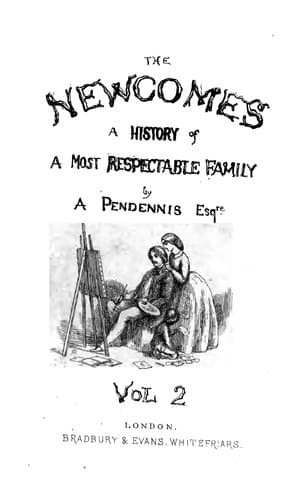
The Newcomes: Memoirs of a Most Respectable FamilyThackeray, William Makepeace
General
The Newcomes: Memoirs of a Most Respectable Family
Thackeray, William Makepeace
Domestic fiction; Families -- England -- Fiction
“Hem! of your poor mother, I—hem—I may say _vidi tantum_. I scarcely
knew her. She married very young: as I was when she left Borhambury.
But Charles exhibited his character at a very early age—and it was not
a charming one—no, by no means a model of virtue. He always had a
genius for running into debt. He borrowed from every one of the
pupils—I don’t know how he spent it except in hardbake and
alycompaine—and even from old Nosey’s groom,—pardon me, we used to call
your grandfather by that playful epithet (boys will be boys, you
know),—even from the doctor’s groom he took money, and I recollect
thrashing Charles Honeyman for that disgraceful action.
“At college, without any particular show, he was always in debt and
difficulties. Take warning by him, dear youth! By him and by me, if you
like. See me—me, F. Bayham, descended from the ancient kings that long
the Tuscan sceptre swayed, dodge down a street to get out of sight of a
boot-shop, and my colossal frame tremble if a chap puts his hand on my
shoulder, as you did, Pendennis, the other day in the Strand, when I
thought a straw might have knocked me down! I have had my errors,
Clive. I know ’em. I’ll take another pint of beer, if you please.
Betsy, has Mrs. Nokes any cold meat in the bar? and an accustomed
pickle? Ha! Give her my compliments, and say F. B. is hungry. I resume
my tale. Faults F. B. has, and knows it. Humbug he may have been
sometimes; but I’m not such a complete humbug as Honeyman.”
Clive did not know how to look at this character of his relative, but
Clive’s companion burst into a fit of laughter, at which F. B. nodded
gravely, and resumed his narrative. “I don’t know how much money he has
had from your governor, but this I can say, the half of it would make
F. B. a happy man. I don’t know out of how much the reverend party has
nobbled his poor old sister at Brighton. He has mortgaged his chapel to
Sherrick, I suppose you know, who is master of it, and could turn him
out any day. I don’t think Sherrick is a bad fellow. I think he’s a
good fellow; I have known him do many a good turn to a chap in
misfortune. He wants to get into society: what more natural? That was
why you were asked to meet him the other day, and why he asked you to
dinner. I hope you had a good one. I wish he’d ask me.
“Then Moss has got his bills, and Moss’s brother-in-law in Cursitor
Street has taken possession of his revered person. He’s very welcome.
One Jew has the chapel, another Hebrew has the clergyman. It’s
singular, ain’t it? Sherrick might turn Lady Whittlesea into a
synagogue and have the Chief Rabbi into the pulpit, where my uncle the
Bishop has given out the text.
Public-domain text, read in full here on John Shaqi.
Reviews
Reviews
No reviews yet
Be the first to share your thoughts on this work.
Elsewhere in the archive
Join the Discussion
Join the discussion
Sign in to leave a comment or review.
Sign InorCreate an account