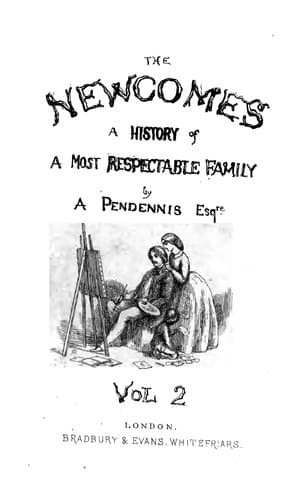
The Newcomes: Memoirs of a Most Respectable FamilyThackeray, William Makepeace
General
The Newcomes: Memoirs of a Most Respectable Family
Thackeray, William Makepeace
Domestic fiction; Families -- England -- Fiction
all, you know, that to see such a fellow refreshes me; and I’d do
anything for him. You’ve made a good thing of that _Pall Mall Gazette!_
I tried papers too; but mine didn’t do. I don’t know why. I tried a
Tory one, moderate Liberal, and out-and-out uncompromising Radical. I
say, what d’ye think of a religious paper, the _Catechism_, or some
such name? Would Honeyman do as editor? I’m afraid it’s all up with the
poor cove at the chapel.” And I parted with Mr. Sherrick, not a little
edified by his talk, and greatly relieved as to Honeyman’s fate. The
tradesmen of Honeyman’s body were appeased; and as for Mr. Moss, when
he found that the curate had no effects, and must go before the
Insolvent Court, unless Moss chose to take the composition which we
were empowered to offer him, he too was brought to hear reason, and
parted with the stamped paper on which was poor Honeyman’s signature.
Our negotiation had like to have come to an end by Clive’s untimely
indignation, who offered at one stage of the proceedings to pitch young
Moss out of window; but nothing came of this most ungentlemanlike
behaviour on Noocob’s part, further than remonstrance and delay in the
proceedings; and Honeyman preached a lovely sermon at Lady Whittlesea’s
the very next Sunday. He had made himself much liked in the
sponging-house, and Mr. Lazarus said, “if he hadn’t a got out time
enough, I’d a let him out for Sunday, and sent one of my men with him
to show him the way ome, you know; for when a gentleman behaves as a
gentleman to me, I behave as a gentleman to him.”
Mrs. Ridley’s account, and it was a long one, was paid without a single
question, or the deduction of a farthing; but the Colonel rather
sickened of Honeyman’s expressions of rapturous gratitude, and received
his professions of mingled contrition and delight very coolly. “My
boy,” says the father to Clive, “you see to what straits debt brings a
man, to tamper with truth to have to cheat the poor. Think of flying
before a washerwoman, or humbling yourself to a tailor, or eating a
poor man’s children’s bread!” Clive blushed, I thought, and looked
rather confused.
“Oh, father,” says he, “I—I’m afraid I owe some money too—not much; but
about forty pound, five-and-twenty for cigars, and fifteen I borrowed
of Pendennis, and—and I’ve been devilish annoyed about it all this
time.”
“You stupid boy,” says the father “I knew about the cigars bill, and
paid it last week. Anything I have is yours, you know. As long as there
is a guinea, there is half for you. See that every shilling we owe is
paid before—before a week is over. And go down and ask Binnie if I can
see him in his study. I want to have some conversation with him.” When
Clive was gone away, he said to me in a very sweet voice, “In God’s
name, keep my boy out of debt when I am gone, Arthur. I shall return to
India very soon.”
“Very soon, sir! You have another year’s leave,” said I.
Public-domain text, read in full here on John Shaqi.
Reviews
Reviews
No reviews yet
Be the first to share your thoughts on this work.
Elsewhere in the archive
Join the Discussion
Join the discussion
Sign in to leave a comment or review.
Sign InorCreate an account