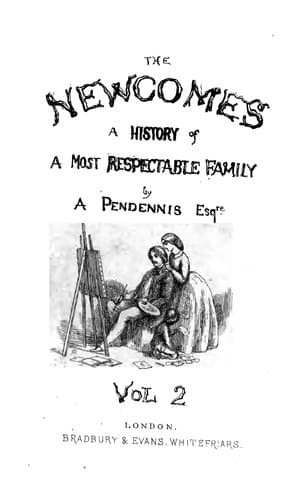
The Newcomes: Memoirs of a Most Respectable FamilyThackeray, William Makepeace
General
The Newcomes: Memoirs of a Most Respectable Family
Thackeray, William Makepeace
Domestic fiction; Families -- England -- Fiction
“She has grown very much since,” says the girl. And an explosion takes
place from the sofa, where the little man is always ready to laugh at
any joke, or anything like a joke, uttered by himself or by any of his
family or friends. As for Doctor Goodenough, he says laughing has saved
that boy’s life.
“She looks quite like a maid,” continues the lady. “She has hard hands,
and she called me mum always. I was quite disappointed in her.” And she
subsides into a novel, with many of which kind of works, and with other
volumes, and with workboxes, and with wonderful inkstands, portfolios,
portable days of the month, scent-bottles, scissor-cases, gilt
miniature easels displaying portraits, and countless gimcracks of
travel, the rapid Kuhn has covered the tables in the twinkling of an
eye.
The person supposed to be the landlady enters the room at this
juncture, and the lady rises to receive her. The little wag on the sofa
puts his arm round his sister’s neck, and whispers, “I say, Eth, isn’t
she a pretty girl? I shall write to Doctor Goodenough and tell him how
much she’s grown.” Convulsions follow this sally, to the surprise of
Hannah, who says, “Pooty little dear!—what time will he have his
dinner, mum?”
“Thank you, Mrs. Honeyman, at two o’clock,” says the lady with a bow of
her head. “There is a clergyman of your name in London; is he a
relation?” The lady in her turn is astonished, for the tall person
breaks out into a grin, and says, “Law, mum, you’re speakin’ of Master
Charles. He’s in London.”
“Indeed!—of Master Charles?”
“And you take me for missis, mum. I beg your pardon, mum,” cries
Hannah. The invalid hits his sister in the side with a weak little
fist. If laughter can cure, _Salva est res_. Doctor Goodenough’s
patient is safe. “Master Charles is missis’s brother, mum. I’ve got no
brother, mum—never had no brother. Only one son, who’s in the police,
mum, thank you. And law bless me, I was going to forget! If you please,
mum, missis says, if you are quite rested, she will pay her duty to
you, mum.”
“Oh, indeed,” says the lady, rather stiffly; and, taking this for an
acceptance of her mistress’s visit, Hannah retires.
“This Miss Honeyman seems to be a great personage,” says the lady. “If
people let lodgings, why do they give themselves such airs?”
“We never saw Monsieur de Boigne at Boulogne, mamma,” interposes the
girl.
“Monsieur de Boigne, my dear Ethel! Monsieur de Boigne is very well.
But—” here the door opens, and in a large cap bristling with ribbons,
with her best chestnut front, and her best black silk gown, on which
her gold watch shines very splendidly, little Miss Honeyman makes her
appearance, and a dignified curtsey to her lodger.
That lady vouchsafes a very slight inclination of the head indeed,
which she repeats when Miss Honeyman says, “I am glad to hear your
ladyship is pleased with the apartments.”
“Yes, they will do very well, thank you,” answers the latter person,
gravely.
Public-domain text, read in full here on John Shaqi.
Reviews
Reviews
No reviews yet
Be the first to share your thoughts on this work.
Elsewhere in the archive
Join the Discussion
Join the discussion
Sign in to leave a comment or review.
Sign InorCreate an account