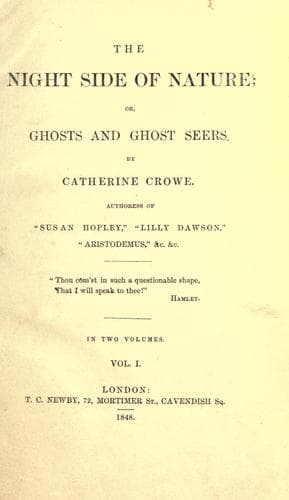
The Night-Side of Nature; Or, Ghosts and Ghost-SeersCrowe, Catherine
Religion
The Night-Side of Nature; Or, Ghosts and Ghost-Seers
Crowe, Catherine
Ghosts; Parapsychology
It is difficult to imagine that all the unfortunate wretches who
suffered death at the stake in the middle ages, for having attended the
unholy assemblies they described, had no faith in their own stories;
yet, in spite of the unwearied vigilance of public authorities and
private malignity, no such assemblage was ever detected. How, then, are
we to account for the pertinacity of their confessions, but by supposing
them the victims of some extraordinary delusion? In a paper addressed to
the Inquisition, by Llorente, he does not scruple to assert that the
crimes imputed to and confessed by witches have most frequently no
existence but in their dreams, and that their dreams are produced by the
drugs with which they anointed themselves.
The recipes for these compositions, which had descended traditionally
from age to age, have been lost since witchcraft went out of fashion,
and modern science has no time to investigate secrets which appear to be
more curious than profitable; but in the profound sleep produced by
these applications, it is not easy to say what phenomena may have
occurred to justify, or, at least, account for, their self-accusations.
-----
[1] This very curious work I have translated from the German. Published
by Moore, London.—C. C. Also republished in this country.—AM. ED.
[2] Since the above was penned, I find from the account of Dr. Cheyne,
who attended him, that Colonel Townshend’s own way of describing the
phenomenon to which he was subject, was, that he “could die, or expire,
when he pleased; and yet, by an effort or _somehow_, he could come to
life again.” He performed the experiment in the presence of three
medical men, one of whom kept his hand on his heart, another held his
wrist, and the third placed a looking-glass before his lips; and they
found that all traces of respiration and pulsation gradually ceased,
insomuch that, after consulting about his condition for some time, they
were leaving the room, persuaded that he was really dead, when signs of
life appeared and he slowly revived. He did not die while repeating this
experiment, as has been sometimes stated.
This reviving “by an effort or somehow,” seems to be better explained by
the hypothesis I have suggested, than by any other—namely, that, as in
the case of Mr. Holloway (mentioned on page 120), his spirit, or soul,
was released from his body, but a sufficient _rapport_ was maintained to
reunite them.
CHAPTER VII.
WRAITHS.
Public-domain text, read in full here on John Shaqi.
Reviews
Reviews
No reviews yet
Be the first to share your thoughts on this work.
Elsewhere in the archive
Join the Discussion
Join the discussion
Sign in to leave a comment or review.
Sign InorCreate an account