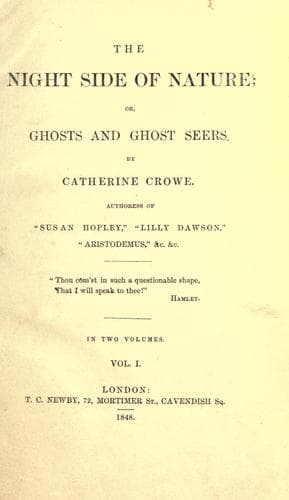
The Night-Side of Nature; Or, Ghosts and Ghost-SeersCrowe, Catherine
Religion
The Night-Side of Nature; Or, Ghosts and Ghost-Seers
Crowe, Catherine
Ghosts; Parapsychology
SUCH instances as that of Lady Fanshawe, and other similar ones,
certainly seem to favor the hypothesis that the spirit is freed from the
body when the latter becomes no longer a fit habitation for it. It does
so when actual death supervenes, and the reason of its departure we may
naturally conclude to be, that the body has ceased to be available for
its manifestations; and in these cases, which seem so nearly allied to
death, that frequently there would actually be no revival but for the
exertions used, it does not seem very difficult to conceive that this
separation may take place. When we are standing by a death-bed, all we
see is the death of the body—of the going forth of the spirit we see
nothing: so, in cases of apparent death, it may depart and return, while
we are aware of nothing but the reanimation of the organism. Certain it
is, that the Scriptures countenance this view of the case in several
instances; thus, Luke says, viii. 34: “And he put them all out, and took
her by the hand, and called, saying, ‘Maid, arise!’ And her spirit came
again, and she arose straightway,” &c., &c.
Dr. Wigan observes, when speaking of the effects of temporary pressure
on the brain, that the mind is not annihilated, because, if the pressure
is timely removed, it is restored, though, if continued too long, the
body will be resolved into its primary elements: and he compares the
human organism to a watch, which we can either stop or set going at
will—which watch, he says, will also be gradually resolved into its
original elements by chemical action; and he adds that, to ask where the
mind is, during the interruption, is like asking where the motion of the
watch is. I think a wind-instrument would be a better simile, for the
motion of the watch is purely mechanical. It requires no informing,
intelligent spirit to breathe into its apertures, and make it the
vehicle of the harshest discords, or of the most eloquent discourses.
“The divinely mysterious essence, which we call the soul,” he adds, “is
not, then, the mind, from which it must be carefully distinguished, if
we would hope to make any progress in mental philosophy. Where the soul
resides during the suspension of the mental powers by asphyxia, I know
not, any more than I know where it resided before it was united with
that specific compound of bones, muscles, and nerve.”
Public-domain text, read in full here on John Shaqi.
Reviews
Reviews
No reviews yet
Be the first to share your thoughts on this work.
Elsewhere in the archive
Join the Discussion
Join the discussion
Sign in to leave a comment or review.
Sign InorCreate an account