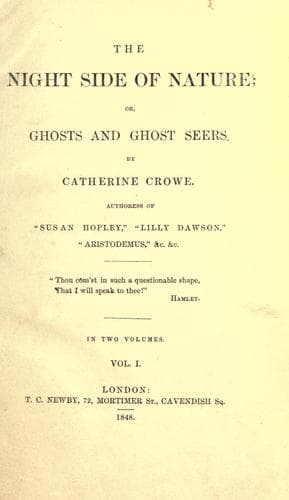
The Night-Side of Nature; Or, Ghosts and Ghost-SeersCrowe, Catherine
Religion
The Night-Side of Nature; Or, Ghosts and Ghost-Seers
Crowe, Catherine
Ghosts; Parapsychology
By a temporary pressure on the brain, the mind is certainly not
annihilated, but its manifestations by means of the brain are
suspended—the source of these manifestations being the soul, or anima,
in which dwells the life, fitting the temple for its divine inhabitant,
the spirit. The connection of the soul and the body is probably a much
more intimate one than that of the latter with the spirit,—though the
soul, as well as the spirit, is immortal, and survives when the body
dies. Somnambulic persons seem to intimate that the soul of the fleshly
body becomes hereafter the body of the spirit, as if the _imago_ or
_idolon_ were the soul.
Dr. Wigan and indeed psychologists in general do not appear to recognise
the old distinction between the pneuma, or anima, and the psyches—the
soul and the spirit; and, indeed, the Scriptures occasionally seem to
use the terms indifferently. But still there are passages enough which
mark the distinction; as where St. Paul speaks of a “living soul and a
quickening spirit:” 1 Cor. xv. 45;—again, 1 Thess. v. 23: “I pray God
your whole spirit, and soul, and body,” &c.;—and also Heb. iv. 12,
where he speaks of the sword of God “dividing asunder the soul and
spirit.” In Genesis, chap. ii., we are told that “man became a living
soul;” but it is distinctly said, 1 Cor. xii., that the gifts of
prophecy, the discerning of spirits, &c., &c., belong to the spirit.
Then, with regard to the possibility of the spirit absenting itself from
the body, St. Paul says, in referring to his own vision—2 Cor. xii.—“I
knew a man in Christ, about fourteen years ago (whether in the body, I
can not tell; or out of the body, I can not tell: God knoweth); such a
one caught up to the third heaven:” and we are told, also, that to be
“absent from the body is to be present with the Lord;” and that when we
are “at home in the body we are absent from the Lord.” We are told,
also, “the spirit returns to God, who gave it;” but it depends on
ourselves whether or not our souls shall perish. We must suppose,
however, that even in the worst cases, some remnant of this divine
spirit remains with the soul as long as the latter is not utterly
perverted and rendered incapable of salvation.
St. John also says, that when he prophesied, he was in the _spirit;_ but
it was the “_souls of the slain_” that he saw, and that “cried with a
loud voice,” &c., &c.; _souls_, here, being probably used in the sense
of individuals,—as we say, so many “souls perished by shipwreck,” &c.
In the _Revue de Paris_, 29th July, 1838, it is related that a child
_saw_ the soul of a woman, who was lying insensible in a magnetic crisis
in which death nearly ensued, depart out of her; and I find recorded in
another work that a somnambule, who was brought to give advice to a
patient, said: “It is too late—her soul is leaving her: I see the vital
flame quitting her brain.”
Public-domain text, read in full here on John Shaqi.
Reviews
Reviews
No reviews yet
Be the first to share your thoughts on this work.
Elsewhere in the archive
Join the Discussion
Join the discussion
Sign in to leave a comment or review.
Sign InorCreate an account