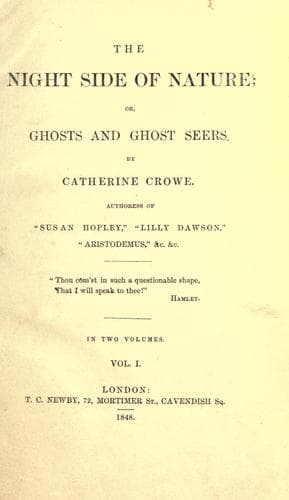
The Night-Side of Nature; Or, Ghosts and Ghost-Seers — John Shaqi
The Night-Side of Nature; Or, Ghosts and Ghost-SeersCrowe, Catherine
Religion
The Night-Side of Nature; Or, Ghosts and Ghost-Seers
Crowe, Catherine
Ghosts; Parapsychology
It is by the hypothesis of this universal sense, latent within us—an
hypothesis which, whoever believes that we are immortal spirits,
incorporated for a season in a material body, can scarcely reject—that
I seek to explain those perceptions which are not comprised within the
functions of our bodily organs. It seems to me to be the key to all or
nearly all of them, as far as our own part in the phenomena extends.
But, supposing this admitted, there would then remain the difficulty of
accounting for the partial and capricious glimpses we get of it; while
in that department of the mystery which regards apparitions, except such
as are the pure result of disease, we must grope our way, with very
little light to guide us, as to the conditions and motives which might
possibly bring them into any immediate relation with us.
To any one who has been fortunate enough to witness one genuine case of
clairvoyance, I think the conception of this universal sense will not be
difficult, however the mode of its exercise may remain utterly
incomprehensible. As I have said above—to the great Spirit and Fountain
of life, all things, in both space and time, must be present. However
impossible it is to our finite minds to conceive this, we must believe
it. It may, in some slight degree, facilitate the conception to remember
that action, once begun, never ceases—an impulse given is transmitted
on for ever; a sound breathed reverberates in eternity; and thus the
past is always present, although, for the purpose of fitting us for this
mortal life, our ordinary senses are so constituted as to be
unperceptive of these phenomena. With respect to what we call _the
future_, it is more difficult still for us to conceive it as present;
nor, as far as I know, can we borrow from the sciences the same
assistance as mechanical discoveries have just furnished me with in
regard to the past. How a spirit sees that which has not yet, to our
senses, taken place, seems certainly inexplicable. _Foreseeing_ it is
not inexplicable: we foresee many things by arguing on given premises,
although, from our own finite views, we are always liable to be
mistaken. Louis Lambert says: “Such events as are the product of
humanity, and the result of its intelligence, have their own causes, in
which they lie latent, just as our actions are accomplished in our
thoughts previous to any outward demonstration of them; presentiments
and prophecies consist in the intuitive perception of these causes.”
This explanation, which is quite conformable with that of Cicero, may
aid us in some degree as regards a certain small class of phenomena; but
there is something involved in the question much more subtle than this.
Our dreams can give us the only idea of it; for there we do actually see
and hear, not only that which never was, but that which never will be.
Actions and events, words and sounds, persons and places, are as clearly
and vividly present to us as if they were actually what they seem; and I
Public-domain text, read in full here on John Shaqi.
Reviews
Reviews
No reviews yet
Be the first to share your thoughts on this work.
Join the Discussion
Join the discussion
Sign in to leave a comment or review.
Sign InorCreate an account