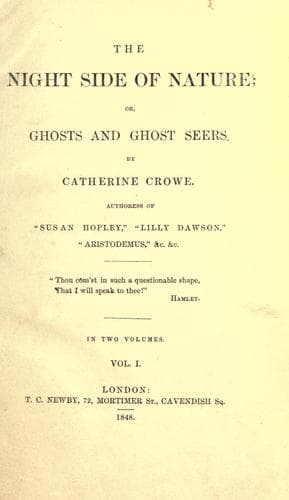
The Night-Side of Nature; Or, Ghosts and Ghost-SeersCrowe, Catherine
Religion
The Night-Side of Nature; Or, Ghosts and Ghost-Seers
Crowe, Catherine
Ghosts; Parapsychology
Dorrien’s uneasiness and worldly care chained him to the earth, and he
was a _restant_—but, being a spirit, he was inevitably inducted into
some of the inherent properties of spirit; matter to him was no
impediment, neither doors nor walls could keep him out; he had the
intuitive perception of whom he could most easily communicate with, or
he was brought into rapport with Oeder by the latter’s seeking him; and
he could either so act on Oeder’s constructive imagination as to enable
it to project his own figure, with the short pipe and the pictures, or
he could, by the magical power of his will, build up these images out of
the constituents of the atmosphere. The last seems the most probable,
because, had the rapport with Oeder, or Oeder’s receptivity, been
sufficient to enable the spirit to act potently upon him, it would have
been also able to infuse into his mind the wishes it desired to convey,
even without speech, for speech, as a means of communication between
spirits, must be quite unnecessary. Even in spite of these dense bodies
of ours, we have great difficulty in concealing our thoughts from each
other; and the somnambule reads the thoughts of not only his magnetizer,
but of others with whom he is placed in rapport. In cases where speech
appears to be used by a spirit, it is frequently not audible speech, but
only this transference of thought, which appears to be speech from the
manner in which the thought is borne in and enters the mind of the
receiver; but it is not through his ears, but through his universal
supplementary sense, that he receives it; and it is no more like what we
mean by _hearing_, than is the seeing of a _clairvoyant_, or a spirit,
like our seeing by means of our bodily organs. In those cases where the
speech is audible to other persons, we must suppose that the magical
will of the spirit can, by means of the atmosphere, simulate these
sounds as it can simulate others, of which I shall have to treat
by-and-by. It is remarkable that, in some instances, this magical power
seems to extend so far as to represent to the eye of the seer a form
apparently so real, solid, and lifelike, that it is not recognisable
from the living man; while in other cases the production of a shadowy
figure seems to be the limit of its agency, whether limited by its own
faculty or the receptivity of its subject: but we must be quite sure
that the form is, in either instance, equally ethereal or immaterial.
And it will not be out of place here to refer to the standing joke of
the skeptics, about ghosts appearing in coats and waistcoats. Bentham
thought he had settled the question for ever by that objection; and I
have heard it since frequently advanced by very acute persons; but,
properly considered, it has not the least validity.
Public-domain text, read in full here on John Shaqi.
Reviews
Reviews
No reviews yet
Be the first to share your thoughts on this work.
Elsewhere in the archive
Join the Discussion
Join the discussion
Sign in to leave a comment or review.
Sign InorCreate an account