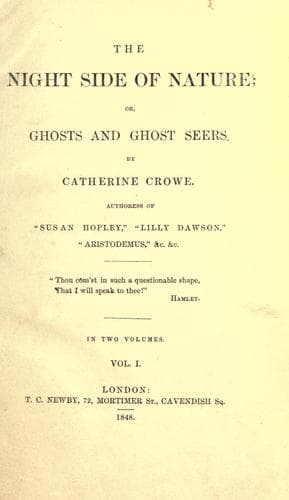
The Night-Side of Nature; Or, Ghosts and Ghost-SeersCrowe, Catherine
Religion
The Night-Side of Nature; Or, Ghosts and Ghost-Seers
Crowe, Catherine
Ghosts; Parapsychology
Whether or not the soul on leaving its earthly tabernacle finds itself
at once clothed with that spiritual body which St. Paul refers to, is
what we can not know, though it seems highly probable; but if it be so,
we must be sure that this body resembles in its nature that fluent,
subtle kind of matter, called by us imponderables, which are capable of
penetrating all substances; and unless there be no visible body at all,
but only the will of a disembodied spirit acting upon one yet in the
flesh (in which case it were as easy to impress the imagination with a
clothed figure as an unclothed one), we must conclude that this ethereal
flexible form, whether permanent or temporary, may be held together and
retain its shape by the volition of the spirit, as our bodies are held
together by the principle of life that is in them; and we see in various
instances, where the spectator has been bold enough to try the
experiment, that though the shadowy body was pervious to any substance
passed through it, its integrity was only momentarily interrupted, and
it immediately recovered its previous shape.
Now, as a spirit—provided there be no especial law to the contrary,
partial or universal, absolute or otherwise, governing the spiritual
world—must be where its thoughts and wishes are, just as we should be
at the place we intently think of, or desire, if our solid bodies did
not impede us, so must a spirit appear as it is, or as it _conceives_ of
itself. Morally, it can only conceive of itself as it is, good or bad,
light or dark; but it may conceive of itself clothed as well as
unclothed; and if it can conceive of its former body, it can equally
conceive of its former habiliments, and so represent them by its power
of will to the eye, or present them to the constructive imagination of
the seer: and it will be able to do this with a degree of distinctness
proportioned to the receptivity of the latter, or to the intensity of
the rapport which exists between them. Now, considered in this way, the
appearance of a spirit “in its habit as it lived” is no more
extraordinary than the appearance of a spirit at all, and it adds no
complexity to the phenomenon. If it appears at all in a recognisable
form, it must come naked or clothed: the former, to say the least of it,
would be much more frightful and shocking; and if it be clothed, I do
not see what right we have to expect it shall be in a fancy costume,
conformable to our ideas (which are no ideas at all) of the other world;
nor why, if it be endowed with the memory of the past, it should not be
natural to suppose it would assume the external aspect it wore during
its earthly pilgrimage. Certain it is, whether consistent with our
notions or not, all tradition seems to show that this is the appearance
they assume; and the very fact that on the first view of the case, and
until the question is philosophically considered, the addition of a suit
of clothes to the phenomenon not only renders its acceptance much more
Public-domain text, read in full here on John Shaqi.
Reviews
Reviews
No reviews yet
Be the first to share your thoughts on this work.
Elsewhere in the archive
Join the Discussion
Join the discussion
Sign in to leave a comment or review.
Sign InorCreate an account