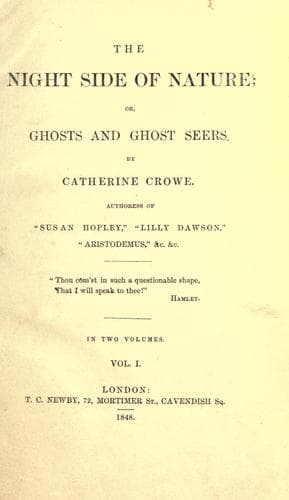
The Night-Side of Nature; Or, Ghosts and Ghost-SeersCrowe, Catherine
Religion
The Night-Side of Nature; Or, Ghosts and Ghost-Seers
Crowe, Catherine
Ghosts; Parapsychology
TO begin with the most simple—or rather, I should say, the most
ordinary—class of phenomena, for we can scarcely call that simple, the
mystery of which we have never been able to penetrate—I mean
dreaming—everybody’s experience will suffice to satisfy them that their
ordinary dreams take place in a state of imperfect sleep, and that this
imperfect sleep may be caused by any bodily or mental derangement
whatever, or even from an ill-made bed, or too much or too little
covering; and it is not difficult to conceive that the strange,
confused, and disjointed visions we are subject to on these occasions,
may proceed from some parts of the brain being less at rest than the
others; so that, assuming phrenology to be fact, one organ is not in a
state to correct the impressions of another. Of such vain and
insignificant visions, I need scarcely say it is not my intention to
treat; but, at the same time, I must observe, that when we have admitted
the above explanation, as far as it goes, we have not, even in regard to
_them_, made much progress toward removing the difficulty. If dreaming
resembled thinking, the explanations might be quite satisfactory; but
the truth is, that dreaming is not thinking, as we think in our waking
state, but is more analogous to thinking in delirium or acute mania, or
in that chronic condition which gives rise to sensuous illusions. In our
ordinary normal state, conceiving of places or persons does not enable
us to see them or hold communion with them, nor do we fancy that we do
either. It is true, that I have heard some painters say that, by closing
their eyes and concentrating their thoughts on an object, they can bring
it more or less vividly before them, and Blake professed actually to see
his sitters when they were not present; but whatever interpretations we
may put upon this curious faculty, his case was clearly abnormal, and
connected with some personal peculiarity, either physical or psychical;
and, after making the most of it, it must be admitted that it can enter
into no sort of comparison with that we possess in sleep, when, in our
most ordinary dreams, untrammelled by time or space, we visit the
uttermost ends of the earth, fly in the air, swim in the sea, listen to
beautiful music and eloquent orations, behold the most charming as well
as the most loathsome objects; and not only see, but converse with our
friends, absent or present, dead or alive. Every one, I think, will
grant that there is the widest possible difference between conceiving of
these things when awake, and dreaming them. When we dream, we do, we
see, we say, we hear, &c., &c., that is, we believe at the time we do
so; and what more can be said of us when we are awake, than that we
_believe_ we are doing, seeing, saying, hearing, &c. It is by external
circumstances, and the results of our actions, that we are able to
decide whether we have actually done a thing or seen a place, or only
Public-domain text, read in full here on John Shaqi.
Reviews
Reviews
No reviews yet
Be the first to share your thoughts on this work.
Join the Discussion
Join the discussion
Sign in to leave a comment or review.
Sign InorCreate an account