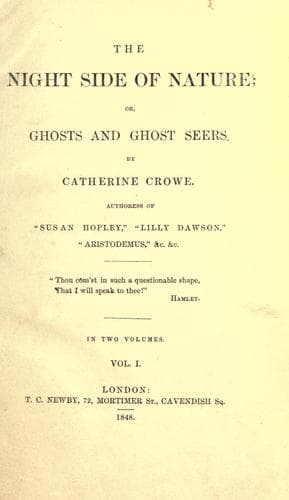
The Night-Side of Nature; Or, Ghosts and Ghost-SeersCrowe, Catherine
Religion
The Night-Side of Nature; Or, Ghosts and Ghost-Seers
Crowe, Catherine
Ghosts; Parapsychology
There are very extraordinary stories extant in all countries, of persons
being annoyed by appearances in the shape of different animals, which
one would certainly be much disposed to give over altogether to the
illusionists; though, at the same time, it is very difficult to reduce
some of the circumstances under that theory—especially one mentioned
page 307 of my “Translation of the Seeress of Prevorst.” If they are not
illusions, they are phenomena, to be attributed either to this plastic
power, or to that magico-magnetic influence in which the belief in
lycanthropy and other strange transformations have originated. The
multitudes of unaccountable stories of this description recorded in the
witch-trials, have long furnished a subject of perplexity to everybody
who was sufficiently just to human nature to conclude, that there must
have been some strange mystery at the bottom of an infatuation that
prevailed so universally, and in which so many sensible, honest, and
well-meaning persons were involved. Till of late years, when some of the
arcana of animal or vital magnetism have been disclosed to us, it was
impossible for us to conceive by what means such strange conceptions
could prevail; but since we now know, and many of us have witnessed,
that all the senses of a patient are frequently in such subjection to
his magnetiser, that they may be made to convey any impressions to the
brain that magnetiser wills, we can without much difficulty conceive how
this belief in the power of transformation took its rise; and we also
know how a magician could render himself visible or invisible at
pleasure. I have seen the sight or hearing of a patient taken away, and
restored by Mr. Spencer Hall in a manner that could leave no doubt on
the mind of the beholder—the evident paralysis of the eye of the
patient testifying to the fact. Monsieur Eusèbe Salverte, the most
determined of rationalistic skeptics, admits that we have numerous
testimonies to the existence of an art, which he confesses himself at
some loss to explain, although the opposite quarters from which the
accounts of it reach us, render it difficult to imagine that the
historians have copied each other. The various transformations of the
gods into eagles, bulls, &c., have been set down as mere mythological
fables; but they appear to have been founded on an art, known in all
quarters of the world, which enabled the magician to take on a form that
was not his own, so as to deceive his nearest and dearest friends. In
the history of Gengis Khan, there is mention of a city which he
conquered—“in which dwelt,” says Suidas, “certain men, who possessed
the secret of surrounding themselves with deceptive appearances,
insomuch that they were able to represent themselves to the eyes of
people quite different to what they really were.” Saxo Grammaticus, in
speaking of the traditions connected with the religion of Odin, says
that “the magi were very expert in the art of deceiving the eyes, being
Public-domain text, read in full here on John Shaqi.
Reviews
Reviews
No reviews yet
Be the first to share your thoughts on this work.
Elsewhere in the archive
Join the Discussion
Join the discussion
Sign in to leave a comment or review.
Sign InorCreate an account