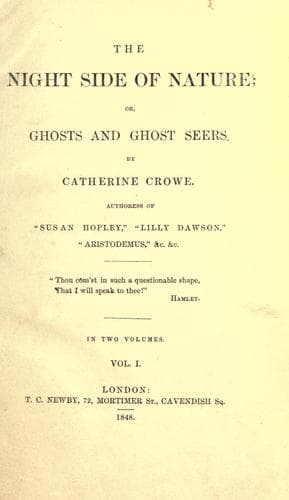
The Night-Side of Nature; Or, Ghosts and Ghost-SeersCrowe, Catherine
Religion
The Night-Side of Nature; Or, Ghosts and Ghost-Seers
Crowe, Catherine
Ghosts; Parapsychology
able to assume, and even to enable others to assume, the forms of
various objects, and to conceal their real aspects under the most
attractive appearances.”
John of Salisbury, who seems to have drawn his information from sources
now lost, says that Mercury, the most expert of magicians, had the art
of fascinating the eyes of men to such a degree as to render people
invisible, or make them appear in forms quite different to what they
really bore. We also learn from an eye-witness that Simon, the magician,
possessed the secret of making another person resemble him so perfectly
that every eye was deceived. Pomponius Mela affirms that the druidesses
of the island of Sena could transform themselves into any animal they
chose, and Proteus has become a proverb by his numerous metamorphoses.
Then, to turn to another age and another hemisphere, we find Joseph
Acosta, who resided a long time in Peru, assuring us that there existed
at that period magicians who had the power of assuming any form they
chose. He relates that the predecessor of Montezuma, having sent to
arrest a certain chief, the latter successively transformed himself into
an eagle, a tiger, and an immense serpent; and so eluded the envoys,
till, having consented to obey the king’s mandate, he was carried to
court and instantly executed.
The same perplexing exploits are confidently attributed to the magicians
of the West Indies; and there were two men eminent among the natives,
the one called Gomez and the other Gonzalez, who possessed this art in
an eminent degree; but both fell victims to the practice of it, being
shot during the period of their apparent transformations.
It is also recorded that Nanuk, the founder of the Sikhs—who are not
properly a nation, but a religious sect—was violently opposed by the
Hindoo zealots; and at one period of his career, when he visited Vatala,
the Yogiswaras—who were recluses, that, by means of corporeal
mortifications, were supposed to have acquired command over the powers
of nature—were so enraged against him, that they strove to terrify him
by their enchantments, assuming the shapes of tigers and serpents. But
they could not succeed, for Nanuk appears to have been a real
philosopher, who taught a pure theism, and inculcated universal peace
and toleration. His tenets, like the tenets of the founders of all
religions, have been since corrupted by his followers. We can scarcely
avoid concluding that the power by which these feats were performed is
of the same nature as that by which a magnetiser persuades his patient
that the water he drinks is beer, or the beer wine; and the analogy
between it and that by which I have supposed a spirit to present
himself, with such accompaniments as he desires, to the eye of a
spectator, is evident. In those instances where female figures are seen
with children in their arm, the appearance of the child we must suppose
to be produced in this manner.
Public-domain text, read in full here on John Shaqi.
Reviews
Reviews
No reviews yet
Be the first to share your thoughts on this work.
Elsewhere in the archive
Join the Discussion
Join the discussion
Sign in to leave a comment or review.
Sign InorCreate an account