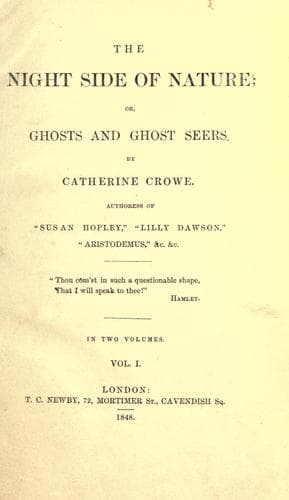
The Night-Side of Nature; Or, Ghosts and Ghost-SeersCrowe, Catherine
Religion
The Night-Side of Nature; Or, Ghosts and Ghost-Seers
Crowe, Catherine
Ghosts; Parapsychology
Dr. Passavent, whose very philosophical work on this occult department
of nature is well worth attention, considers the fact of these
appearances far too well established to be disputed; and he enters into
some curious disquisitions with regard to what the Germans call
_far-working_, or the power of acting on bodies at a distance without
any sensible conductor, instancing the case of a gymnotus, which was
kept alive for four months in Stockholm, and which, when urged by
hunger, could kill fish at a distance without contact, adding that it
rarely miscalculated the amount of the shock necessary to its purpose.
These and all such effects are attributed by this school of
physiologists to the supposed imponderable—the nervous ether I have
elsewhere mentioned—which Dr. Passavent conceives, in cases of
somnambulism, certain sicknesses, and the approach of death, to be less
closely united to its material conductors, the nerves, and therefore
capable of being more or less detached, and acting at a distance,
especially on those with whom relationship, friendship, or love,
establishes a rapport, or polarity; and he observes that intervening
substances or distance can no more impede this agency than they do the
agency of mineral magnetism. And he considers that we must here seek for
the explanation of those curious so-called coincidences of pictures
falling, and clocks and watches stopping, at the moment of a death,
which we frequently find recorded.
With respect to the wraiths, he observes that the more the ether is
freed, as by trance or the immediate approach of death, the more easily
the soul sets itself in rapport with distant persons; and that thus it
either acts magically, so that the seer perceives the real actual body
of the person that is acting upon him, or else that he sees the ethereal
body, which presents the perfect form of the fleshly one, and which,
while the organic life proceeds, can be momentarily detached and appear
elsewhere; and this ethereal body he holds to be the fundamental form,
of which the external body is only the copy, or husk.
Public-domain text, read in full here on John Shaqi.
Reviews
Reviews
No reviews yet
Be the first to share your thoughts on this work.
Elsewhere in the archive
Join the Discussion
Join the discussion
Sign in to leave a comment or review.
Sign InorCreate an account