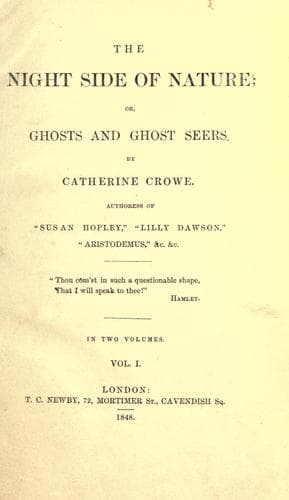
The Night-Side of Nature; Or, Ghosts and Ghost-SeersCrowe, Catherine
Religion
The Night-Side of Nature; Or, Ghosts and Ghost-Seers
Crowe, Catherine
Ghosts; Parapsychology
I confess, I much prefer this theory of Dr. Passavent’s, which seems to
me to go very much to the root of the matter. We have here the
“spiritual body” of St. Paul, and the “nerve-spirit” of the
somnambulists, and their magical effects are scarcely more
extraordinary, if properly considered, than their agency on our own
_material_ bodies. It is this ethereal body which obeys the intelligent
spirit within, and which is the intermediate agent between the spirit
and the fleshly body. We here find the explanation of wraiths, while
persons are in trance, or deep sleep, or comatose, this ethereal body
can be detached and appear elsewhere; and I think there can be no great
difficulty for those who can follow us so far, to go a little further,
and admit that this ethereal body must be indestructible, and survive
the death of the material one; and that it may, therefore, not only
become visible to us under given circumstances, but that it may, also,
produce effects bearing some similarity to those it was formerly capable
of, since, in acting on our bodies during life, it is already acting on
a material substance in a manner so incomprehensible to us, that we
might well apply the word _magical_ when speaking of it, were it not
that custom has familiarized us to the marvel.
It is to be observed, that this idea of a spiritual body is one that
pervaded all Christendom in the earlier and purer ages of Christianity,
before priestcraft—and by priestcraft I mean the priestcraft of all
denominations—had overshadowed and obscured, by its various sectarian
heresies, the pure teaching of Jesus Christ.
Dr. Ennemoser mentions a curious instance of this _actio in distans_, or
far-working. It appears that Van Helmont having asserted that it was
possible for a man to extinguish the life of an animal by the eye alone
(_oculis intentis_), Rousseau, the naturalist, repeated the experiment,
when in the East, and in this manner killed several toads; but on a
subsequent occasion, while trying the same experiment at Lyons, the
animal, on finding it could not escape, fixed its eyes immovably on him,
so that he fell into a fainting fit, and was thought to be dead. He was
restored by means of theriacum and viper powder—a truly homeopathic
remedy! However, we here probably see the origin of the universal
popular persuasion, that there is some mysterious property in the eye of
a toad; and also of the so called, superstition of the _evil eye_.
Public-domain text, read in full here on John Shaqi.
Reviews
Reviews
No reviews yet
Be the first to share your thoughts on this work.
Elsewhere in the archive
Join the Discussion
Join the discussion
Sign in to leave a comment or review.
Sign InorCreate an account