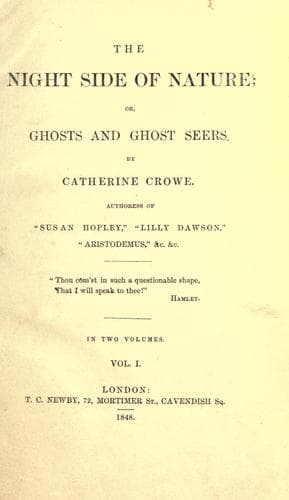
The Night-Side of Nature; Or, Ghosts and Ghost-SeersCrowe, Catherine
Religion
The Night-Side of Nature; Or, Ghosts and Ghost-Seers
Crowe, Catherine
Ghosts; Parapsychology
The power of _will_ is a phenomenon that has been observed in all ages
of the world, though of late years much less than at an earlier period;
and, as it was then more frequently exerted for evil than good, it was
looked upon as a branch of the art of black magic, while the philosophy
of it being unknown, the devil was supposed to be the real agent, and
the witch, or wizard, only his instrument. The profound belief in the
existence of this art is testified by the twelve tables of Rome, as well
as by the books of Moses, and those of Plato, &c. It is extremely absurd
to suppose that all these statutes were enacted to suppress a crime
which never existed: and, with regard to these witches and wizards, we
must remember, as Dr. Ennemoser justly remarks, that the force of will
has no relation to the strength or weakness of the body: witness the
extraordinary feats occasionally performed by feeble persons under
excitement, &c.; and, although these witches and wizards were frequently
weak, decrepit people, they either believed in their own arts, or else
that they had a friend or coadjutor in the devil, who was able and
willing to aid them. They, therefore, did not doubt their own power, and
they had the one great requisite, _faith_. To _will and to believe_, was
the explanation given by the Marquis de Puységur of the cures he
performed; and this unconsciously becomes the recipe of all such men as
Greatrix, the Shepherd of Dresden, and many other wonder-workers, and
hence we see why it is usually the humble, the simple and the
child-like, the solitary, the recluse, nay, the ignorant, who exhibit
traces of these occult faculties; for he who can not believe can not
_will_, and the skepticism of the intellect disables the magician; and
hence we say, also, wherefore, in certain parts of the world and in
certain periods of its history, these powers and practices have
prevailed. They were believed in because they existed; and they existed
because they were believed in. There was a continued interaction of
cause and effect—of faith and works. People who look superficially at
these things, delight in saying that the more the witches were
persecuted the more they abounded; and that when the persecution ceased
we heard no more of them. Naturally, the more they were persecuted the
more they believed in witchcraft and in themselves; when persecution
ceased, and men in authority declared that there was no such thing as
witchcraft or witches, they lost their faith, and with it that little
sovereignty over nature that that faith had conquered.
Public-domain text, read in full here on John Shaqi.
Reviews
Reviews
No reviews yet
Be the first to share your thoughts on this work.
Elsewhere in the archive
Join the Discussion
Join the discussion
Sign in to leave a comment or review.
Sign InorCreate an account