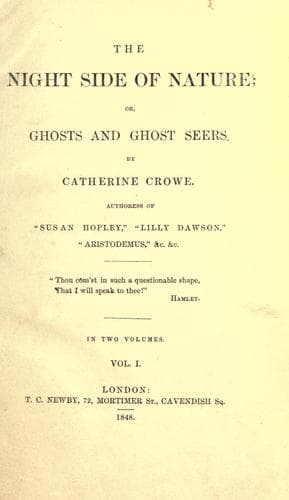
The Night-Side of Nature; Or, Ghosts and Ghost-SeersCrowe, Catherine
Religion
The Night-Side of Nature; Or, Ghosts and Ghost-Seers
Crowe, Catherine
Ghosts; Parapsychology
But, then, there is the visible body of the spirit—what is that, and
how does it retain its shape?—for we know that there is a law
(discovered by Dalton) that two masses of gaseous matter can not remain
in contact, but they will immediately proceed to diffuse themselves into
one another; and accordingly, it may be advanced that a gaseous
corporeity in the atmosphere is an impossibility, because it could not
retain its form, but would inevitably be dissolved away, and blend with
the surrounding air. But precisely the same objection might be made by a
chemist to the possibility of our fleshly bodies retaining their
integrity and compactness: for the human body, taken as a whole, is
known to be an impossible chemical compound, except for the vitality
which upholds it; and no sooner is life withdrawn from it, than it
crumbles into putrescence; and it is undeniable that the aeriform body
would be an impossible mechanical phenomenon, but for the vitality
which, we are entitled to suppose, may uphold it. But, just as the state
or condition of organization protects the fleshly body from the natural
reactions which would destroy it, so may an analogous condition of
organization protect a spiritual ethereal body from the destructive
influence of the mutual interdiffusion of gases.
Thus, supposing this aeriform body to be a permanent appurtenance of the
spirit, we see how it may subsist and retain its integrity; and it would
be as reasonable to hope to exclude the electric fluid by walls or doors
as to exclude by them this subtle, fluent form. If, on the contrary, the
shape be only one constructed out of the atmosphere by an act of will,
the same act of will, which is a vital force, will preserve it entire,
until, the will being withdrawn, it dissolves away. In either case, the
moment the will or thought of the spirit is elsewhere, it is gone—it
has vanished.
For those who prefer the other hypothesis—namely, that there is no
outstanding shape at all, but that the will of the spirit, acting on the
constructive imagination of the seer, enables him to conceive the form,
as the spirit itself conceives of it—there can be no difficulty in
understanding that the becoming invisible will depend merely on a
similar act of will.
CHAPTER XIII.
HAUNTED HOUSES.
Public-domain text, read in full here on John Shaqi.
Reviews
Reviews
No reviews yet
Be the first to share your thoughts on this work.
Elsewhere in the archive
Join the Discussion
Join the discussion
Sign in to leave a comment or review.
Sign InorCreate an account