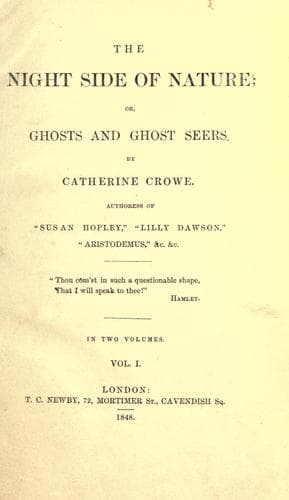
The Night-Side of Nature; Or, Ghosts and Ghost-Seers — John Shaqi
The Night-Side of Nature; Or, Ghosts and Ghost-SeersCrowe, Catherine
Religion
The Night-Side of Nature; Or, Ghosts and Ghost-Seers
Crowe, Catherine
Ghosts; Parapsychology
In the histories of the Old Testament we constantly find instances of
prophetic dreaming, and the voice of God was chiefly heard by the
prophets in sleep; seeming to establish that man is in that state more
susceptible of spiritual communion, although the being thus made the
special organ of the Divine will, is altogether a different thing from
the mere disfranchisement of the embodied spirit in ordinary cases of
clear seeing in sleep. Profane history, also, furnishes us with various
instances of prophetic dreaming, which it is unnecessary for me to refer
to here. But there is one thing very worthy of remark, namely, that the
allegorical character of many of the dreams recorded in the Old
Testament, occasionally pervades those of the present day. I have heard
of several of this nature, and Oberlin, the good pastor of Ban de la
Roche, was so subject to them, that he fancied he had acquired the art
of interpreting the symbols. This characteristic of dreaming is in
strict conformity with the language of the Old Testament, and of the
most ancient nations. Poets and prophets, heathen and Christian, alike
express themselves symbolically, and, if we believe that this language
prevailed in the early ages of the world, before the external and
intellectual life had predominated over the instinctive and emotional,
we must conclude it to be the natural language of man, who must,
therefore, have been gifted with a conformable faculty of comprehending
these hieroglyphics; and hence it arose that the interpreting of dreams
became a legitimate art. Long after these instinctive faculties were
lost, or rather obscured, by the turmoil and distractions of sensuous
life, the memories and traditions of them remained, and hence the
superstructure of jugglery and imposture that ensued, of which the
gipsies form a signal example, in whom, however, there can be no doubt
that some occasional gleams of this original endowment may still be
found, as is the case, though more rarely, in individuals of all races
and conditions. The whole of nature is one large book of symbols, which,
because we have lost the key to it, we can not decipher. “To the first
man,” says Hamann, “whatever his ear heard, his eye saw, or his hand
touched, was a living word; with this word in his heart and in his
mouth, the formation of language was easy. Man saw things in their
essence and properties, and named them accordingly.”
There can be no doubt that the heathen forms of worship and systems of
religion were but the external symbols of some deep meanings, and not
the idle fables that they have been too frequently considered; and it is
absurd to suppose that the theology which satisfied so many great minds
had no better foundation than a child’s fairy tale.
Public-domain text, read in full here on John Shaqi.
Reviews
Reviews
No reviews yet
Be the first to share your thoughts on this work.
Join the Discussion
Join the discussion
Sign in to leave a comment or review.
Sign InorCreate an account