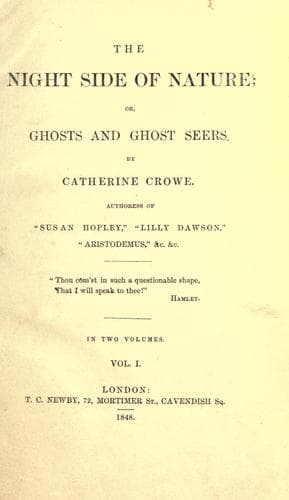
The Night-Side of Nature; Or, Ghosts and Ghost-SeersCrowe, Catherine
Religion
The Night-Side of Nature; Or, Ghosts and Ghost-Seers
Crowe, Catherine
Ghosts; Parapsychology
Jung Stilling publishes a similar account, which was bequeathed to him
by a very worthy and pious minister of the church. The subject of the
guardianship was his own wife, and the spirit first appeared to her
after her marriage, in the year 1799, as a child, attired in a white
robe, while she was busy in her bed-chamber. She stretched out her hand
to take hold of the figure, but it disappeared. It frequently visited
her afterward, and in answer to her inquiries it said, “I died in my
childhood!” It came to her at all hours, whether alone or in company,
and not only at home, but elsewhere, and even when travelling, assisting
her when in danger; it sometimes floated in the air, spake to her in its
own language, which somehow, she says, she understood, and could speak,
too; and it was once seen by another person. He bade her call him
_Immanuel_. She earnestly begged him to show himself to her husband, but
he alleged that it would make him ill, and cause his death. On asking
him _wherefore_, he answered, “Few persons are able to see such things.”
Her two children, one six years old, and the other younger, saw this
figure as well as herself.
Schubert, in his “Geschichte der Seele,” relates that the ecclesiastical
councillor Schwartz, of Heidelberg, when about twelve years of age, and
at a time that he was learning the Greek language, but knew very little
about it, dreamed that his grandmother, a very pious woman, to whom he
had been much attached, appeared to him, and unfolded a parchment
inscribed with Greek characters which foretold the fortunes of his
future life. He read it off with as much facility as if it had been in
German, but being dissatisfied with some particulars of the prediction,
he begged they might be changed. His grandmother answered him in Greek,
whereupon he awoke, remembering the dream, but, in spite of all the
efforts to arrest them, he was unable to recall the particulars the
parchment had contained. The answer of his grandmother, however, he was
able to grasp before it had fled his memory, and he wrote down the
words; but the meaning of them he could not discover without the
assistance of his grammar and lexicon. Being interpreted, they proved to
be these: “As it is prophesied to me, so I prophesy to thee!” He had
written the words in a volume of Gessner’s works, being the first thing
he laid his hand on; and he often philosophized on them in later days,
when they chanced to meet his eye. How, he says, should he have been
able to read and produce that in his sleep, which, in his waking state,
he would have been quite incapable of? “Even long after, when I left
school,” he adds, “I could scarcely have put together such a sentence;
and it is extremely remarkable that the feminine form was observed in
conformity with the sex of the speaker.” The words were these: αῦτα
Χρησμ῾ωδηθεισα Χρησμωδὲω σοι.
Public-domain text, read in full here on John Shaqi.
Reviews
Reviews
No reviews yet
Be the first to share your thoughts on this work.
Elsewhere in the archive
Join the Discussion
Join the discussion
Sign in to leave a comment or review.
Sign InorCreate an account