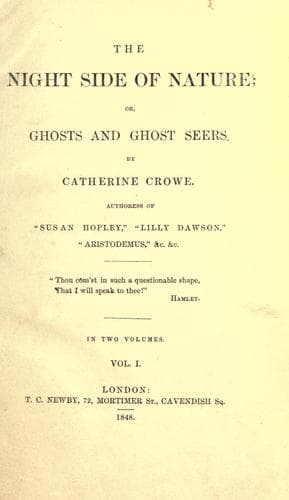
The Night-Side of Nature; Or, Ghosts and Ghost-SeersCrowe, Catherine
Religion
The Night-Side of Nature; Or, Ghosts and Ghost-Seers
Crowe, Catherine
Ghosts; Parapsychology
Grotius relates, that when Mr. de Saumaise was councillor of the
parliament at Dijon, a person, who knew not a word of Greek, brought him
a paper on which was written some words in that language, but not in the
character. He said that a voice had uttered them to him in the night,
and that he had written them down, imitating the sound as well as he
could. Mons de Saumaise made out that the signification of the words
was, “Begone! do you not see that death impends?” Without comprehending
what danger was predicted, the person obeyed the mandate and departed.
On that night the house that he had been lodging in fell to the ground.
The difficulty in these two cases is equally great, apply to it whatever
explanation we may; for even if the admonitions proceeded from some
friendly guardian, as we might be inclined to conclude, it is not easy
to conceive why they should have been communicated in a language the
persons did not understand.
After the death of Dante, it was discovered that the thirteenth canto of
the “Paradiso” was missing; great search was made for it, but in vain;
and to the regret of everybody concerned, it was at length concluded
that it had either never been written, or had been destroyed. The quest
was therefore given up, and some months had elapsed, when Pietro
Allighieri, his son, dreamed that his father had appeared to him and
told him that if he removed a certain panel near the window of the room
in which he had been accustomed to write, the thirteenth canto would be
found. Pietro told his dream, and was laughed at, of course; however, as
the canto did not turn up, it was thought as well to examine the spot
indicated in the dream. The panel was removed, and there lay the missing
canto behind it; much mildewed, but, fortunately, still legible.
If it be true that the dead do return sometimes to solve our
perplexities, here was not an unworthy occasion for the exercise of such
a power. We can imagine the spirit of the great poet still clinging to
the memory of his august work, immortal as himself—the record of those
high thoughts which can never die.
Public-domain text, read in full here on John Shaqi.
Reviews
Reviews
No reviews yet
Be the first to share your thoughts on this work.
Elsewhere in the archive
Join the Discussion
Join the discussion
Sign in to leave a comment or review.
Sign InorCreate an account