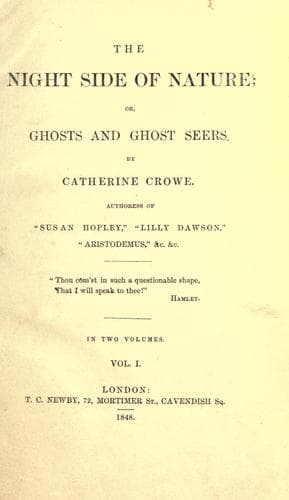
The Night-Side of Nature; Or, Ghosts and Ghost-SeersCrowe, Catherine
Religion
The Night-Side of Nature; Or, Ghosts and Ghost-Seers
Crowe, Catherine
Ghosts; Parapsychology
Since we look upon lotteries, in this country, as an immoral species of
gambling, it may be raised as an objection to this dream, that such
intelligence was an unworthy mission for a spirit, supposing the
communication to have been actually made by Collin. But, in the first
place, we have only to do with facts, and not with their propriety or
impropriety, according to our notions; and, by-and-by, I shall endeavor
to show that such discrepancies possibly arise from the very erroneous
notions commonly entertained of the state of those who have disappeared
from the terrestrial life.
Simonides the poet, arriving at the seashore with the intention of
embarking on board a vessel on the ensuing day, found an unburied body,
which he immediately desired should be decently interred. On the same
night, this deceased person appeared to him, and bade him by no means go
to sea, as he had proposed. Simonides obeyed the injunction, and beheld
the vessel founder, as he stood on the shore. He raised a monument on
the spot to the memory of his preserver, which is said still to exist,
on which are engraven some lines, to the effect that it was dedicated by
Simonides, the poet of Cheos, in gratitude to the dead who had preserved
him from death.
A much-esteemed secretary died a few years since, in the house of Mr.
R—— von N——. About eight weeks afterward, Mr. R—— himself being
ill, his daughter dreamed that the house-bell rang, and that, on looking
out, she perceived the secretary at the door. Having admitted him, and
inquired what he was come for, he answered, “To fetch somebody.” Upon
which, alarmed for her father, she exclaimed, “I hope not my father!” He
shook his head solemnly, in a manner that implied it was not the old man
he had come for, and turned away toward a guest-chamber, at that time
vacant, and there disappeared at the door. The father recovered, and the
lady left home for a few days, on a visit. On her return, she found her
brother had arrived in the interval to pay a visit to his parents, and
was lying sick in that room, where he died.
I will here mention a curious circumstance regarding Mr. H——, the
gentleman alluded to in a former page, who, being at the seaside, saw,
in a dream, the danger that awaited his son when he went to bathe. This
gentleman has frequently, on waking, felt a consciousness that he had
been conversing with certain persons of his acquaintance—and, indeed,
with some of whom he knew little—and has afterward, not without a
feeling of awe, learned that these persons had died during the hours of
his sleep.
Do not such circumstances entitle us to entertain the idea that I have
suggested above, namely, that in sleep the spirit is free to see, and to
know, and to communicate with spirit, although the memory of this
knowledge is rarely carried into the waking state?
Public-domain text, read in full here on John Shaqi.
Reviews
Reviews
No reviews yet
Be the first to share your thoughts on this work.
Elsewhere in the archive
Join the Discussion
Join the discussion
Sign in to leave a comment or review.
Sign InorCreate an account