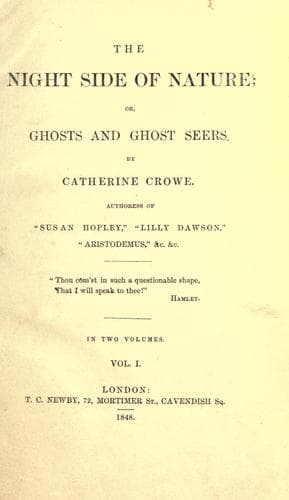
The Night-Side of Nature; Or, Ghosts and Ghost-SeersCrowe, Catherine
Religion
The Night-Side of Nature; Or, Ghosts and Ghost-Seers
Crowe, Catherine
Ghosts; Parapsychology
The story of the two Arcadians, who travelled together to Megara, though
reprinted in other works, I can not omit here. One of these established
himself, on the night of their arrival, at the house of a friend, while
the other sought shelter in a public lodging-house for strangers. During
the night, the latter appeared to the former, in a dream, and besought
him to come to his assistance, as his villanous host was about to take
his life, and only the most speedy aid could save him. The dreamer
started from his sleep, and his first movement was to obey the summons,
but, reflecting that it was only a dream, he presently lay down, and
composed himself again to rest. But now his friend appeared before him a
second time, disfigured by blood and wounds, conjuring him, since he had
not listened to his first entreaties, that he would, at least, avenge
his death. His host, he said, had murdered him, and was, at that moment,
depositing his body in a dung-cart, for the purpose of conveying it out
of the town. The dreamer was thoroughly alarmed, arose, and hastened to
the gates of the city, where he found, waiting to pass out, exactly such
a vehicle as his friend had described. A search being instituted, the
body was found underneath the manure; and the host was consequently
seized, and delivered over to the chastisement of the law.
“Who shall venture to assert,” says Dr. Ennemoser, “that this communing
with the dead in sleep is merely a subjective phenomenon, and that the
presence of these apparitions is a pure illusion?”
A circumstance fully as remarkable as any recorded, occurred at Odessa,
in the year 1842. An old blind man, named Michel, had for many years
been accustomed to get his living by seating himself every morning on a
beam in one of the timber-yards, with a wooden bowl at his feet, into
which the passengers cast their alms. This long-continued practice had
made him well known to the inhabitants, and, as he was believed to have
been formerly a soldier, his blindness was attributed to the numerous
wounds he had received in battle. For his own part, he spoke little, and
never contradicted this opinion.
Public-domain text, read in full here on John Shaqi.
Reviews
Reviews
No reviews yet
Be the first to share your thoughts on this work.
Elsewhere in the archive
Join the Discussion
Join the discussion
Sign in to leave a comment or review.
Sign InorCreate an account