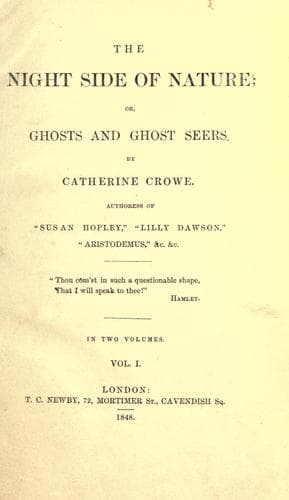
The Night-Side of Nature; Or, Ghosts and Ghost-SeersCrowe, Catherine
Religion
The Night-Side of Nature; Or, Ghosts and Ghost-Seers
Crowe, Catherine
Ghosts; Parapsychology
The two following cases seem rather to belong to what is called, in the
east, _second hearing_,—although sympathy was probably the exciting
cause of the phenomena. A lady and gentleman in Berwickshire were
awakened one night by a loud cry, which they both immediately recognised
to proceed from the voice of their son, who was then absent and at a
considerable distance. Tidings subsequently reached them, that exactly
at that period their son had fallen overboard and was drowned. On
another occasion, in Perthshire, a person aroused her husband one night,
saying that their son was drowned, for she had been awakened by the
splash. Her presentiment also proved too well founded, the young man
having fallen from the mast-head of the ship. In both cases, we may
naturally conclude that the thoughts of the young men, at the moment of
the accident, would rush homeward; and, admitting Dr. Ennemoser’s theory
of polarity, the passive sleepers became the recipients of the force. I
confess, however, that the opinions of another section of philosophers
appear to me to be more germain to the matter; although, to many
persons, they will doubtless be difficult of acceptance, from their
appertaining to those views commonly called mystical.
These psychologists then believe, as did Socrates and Plato, and others
of the ancients, that in certain conditions of the body, which
conditions may arise naturally, or be produced artificially, the links
which unite it with the spirit may be more or less loosened; and that
the latter may thus be temporarily disjoined from the former, and so
enjoy a foretaste of its future destiny. In the lowest or first degree
of this disunion, we are awake, though scarcely conscious, while the
imagination is vivified to an extraordinary amount, and our fancy
supplies images almost as lively as the realities. This probably is the
temporary condition of inspired poets and eminent discoverers.
Sleep is considered another stage of this disjunction; and the question
has ever been raised whether, when the body is in profound sleep, the
spirit is not altogether free and living in another world, while the
organic life proceeds as usual, and sustains the temple till the return
of its inhabitant. Without at present attempting to support or refute
this doctrine, I will only observe, that once admitting the possibility
of the disunion, all consideration of _time_ must be set aside as
irrelevant to the question; for spirit, freed from matter, must move
with the rapidity of thought;—in short, _a spirit must be where its
thoughts and affections are_.
Public-domain text, read in full here on John Shaqi.
Reviews
Reviews
No reviews yet
Be the first to share your thoughts on this work.
Elsewhere in the archive
Join the Discussion
Join the discussion
Sign in to leave a comment or review.
Sign InorCreate an account