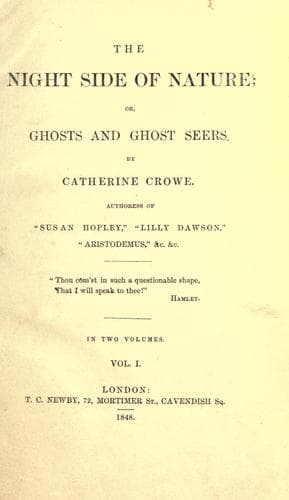
The Night-Side of Nature; Or, Ghosts and Ghost-SeersCrowe, Catherine
Religion
The Night-Side of Nature; Or, Ghosts and Ghost-Seers
Crowe, Catherine
Ghosts; Parapsychology
It is the opinion of these psychologists, however, that in the normal
and healthy condition of man, the union of body, soul, and spirit, is
most complete, and that all the degrees of disunion in the waking state
are degrees of morbid derangement. Hence it is that somnambulists and
clairvoyants are chiefly to be found among sickly women. There have been
persons who have appeared to possess a power which they could exert at
will, whereby they withdrew from their bodies, these remaining during
the absence of the spirit in a state of catalepsy, scarcely if at all to
be distinguished from death.
I say _withdrew from their bodies_, assuming that to be the explanation
of the mystery; for, of course, it is but an assumption. Epimenides is
recorded to have possessed this faculty; and Hermotinus, of Clazomenes,
is said to have wandered, in spirit, over the world, while his body lay
apparently dead. At length his wife, taking advantage of this absence of
his soul, burned his body and thus intercepted its return: so say Lucien
and Pliny the elder;—and Varro relates, that the eldest of two
brothers, named Corfidius, being supposed to die, his will was opened
and preparations were made for his funeral by the other brother, who was
declared his heir. In the meantime, however, Corfidius revived, and told
the astonished attendants, whom he summoned by clapping his hands, that
he had just come from his younger brother, who had committed his
daughter to his care, and informed him where he had buried some gold,
requesting that the funeral preparations he had made might be converted
to his own use. Immediately afterward, the news arrived that the younger
brother was unexpectedly deceased, and the gold was found at the place
indicated. The last appears to have been a case of natural trance; but
the two most remarkable instances of voluntary trance I have met with in
modern times is that of Colonel Townshend, and the dervish who allowed
himself to be buried. With regard to the former, he could, to all
appearance, die whenever he pleased; his heart ceased to beat; there was
no perceptible respiration; and his whole frame became cold and rigid as
death itself; the features being shrunk and colorless, and the eyes
glazed and ghastly. He would continue in this state for several hours
and then gradually revive; but the revival does not appear to have been
an effort of will—or rather, we are not informed whether it was so or
not. Neither are we told whether he brought any recollections back with
him, nor how this strange faculty was first developed or discovered—all
very important points, and well worthy of investigation.[2]
Public-domain text, read in full here on John Shaqi.
Reviews
Reviews
No reviews yet
Be the first to share your thoughts on this work.
Elsewhere in the archive
Join the Discussion
Join the discussion
Sign in to leave a comment or review.
Sign InorCreate an account