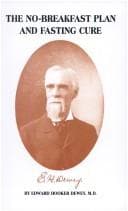
The No Breakfast Plan and the Fasting-CureDewey, Edward Hooker
Science
The No Breakfast Plan and the Fasting-Cure
Dewey, Edward Hooker
Fasting; Nutrition
The literature on what to eat and not to eat, what to do and not to do,
on medicines that convert human stomachs into drug-stores, is simply
boundless. If we believe all we read, we must consider the location we
are in before we can safely draw the breath of life; we must not cool
our parched throats without the certificate of the microscope. We must
not eat without an ultimate analysis of each item of the bill of fare,
as we would take an account of stock before ordering fresh goods; and
this without ever knowing how much lime we need for the bones, iron for
the blood, phosphorus for the brain, or nitrogen for the muscles. In
short, there is death in the air we breathe, death in the food we eat,
death in the water we drink, until, verily, we seem to walk our ways of
life in the very valley and shadow of death, ever subject to the attack
of hobgoblins of disease.
How many lives would go down in despair but for the miracles of cure
promised in the public prints, even in our best journals and monthlies,
we cannot know. It is the hope for better things that sustains our
lives; suicide never occurs until all hope has departed. Even our
medical journals are heavily padded with pages of new remedies whose use
involves the most amazing credulity. Perhaps it is well, in the absence
of a sound physiological hygiene, that the people who are sick and
afflicted shall be buoyed up by fresh, printed promises. Perhaps it is
also well for the physician to be able to go into the rooms of the sick
inspired from the advertising pages of his favorite medical journals.
Are they not new stars of hope to both physician and the people? Why
should we not hope when new remedies are multiplying in such infinite
excess over newly discovered diseases? _New diseases?_ What is there
essentially new that can be treated with remedies, in the coated
tongues, foul mouths, high temperature and pulse, pain, discomfort, and
acute aversion to food, that is to be found in the rooms of the sick?
Are there really specifics for these conditions?
The hygiene to be unfolded in these pages is so new, so revolutionary,
that its first impress has never failed to excite every form of
opposition known to language, and yet its practicality is so great that
it is rarely questioned by those who fairly test it. It has not been
found wanting in its physiology, nor has it failed to grow wherever it
has found lodgement.
The origin and development of this new way in health culture seem to
require something of professional autobiography, that it may be seen
that it is a matter of evolution and not of chance, not a fad that has
only its passing hour.
Public-domain text, read in full here on John Shaqi.
Reviews
Reviews
No reviews yet
Be the first to share your thoughts on this work.
Join the Discussion
Join the discussion
Sign in to leave a comment or review.
Sign InorCreate an account