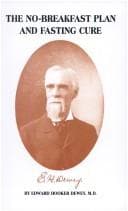
The No Breakfast Plan and the Fasting-CureDewey, Edward Hooker
Science
The No Breakfast Plan and the Fasting-Cure
Dewey, Edward Hooker
Fasting; Nutrition
"'But I sincerely hope Mr. Rathbun will have no imitators. It
would be a very unfortunate thing, fraught with grave
possibilities, if the newspaper accounts of his reduction in
weight and general improvement in health were to move others to
follow his example. Many persons would be injured for life,
physically wrecked, and perhaps actually killed if they
conscientiously did the fifth part of what he is said to have
done.
* * * * *
"'And right here it may be said that there is a great deal of
exaggeration in the sweeping statements made about people eating
too much. If a man sleeps well, goes about his business in a
cheerful frame of mind, and does not get what is called
"out-of-sorts," he may be pretty sure he is not eating too much,
even though he eat a good deal. My observation is that the
average man who works and gets a proper amount of exercise does
not eat too much. If you want to get work done by the engine,
you have got to stoke up the furnace. If a man wants to keep his
vital energies up to par he has got to put in the fuel--that is,
the food.
"'Of course, there are those who lead sedentary lives who get
too much absorbed in the pleasures of the table and overfeed.
There are a sufficient number of these, to be sure, but I think
they are the exception. But it will be a sad mistake if even
they seek a road to health by Mr. Rathbun's starvation
methods.'"
The doctor is astonished, and so am I that he is astonished. This would
seem to imply that he has never had cases of acute sickness in which the
amount of food taken during many days or even weeks was too small to
play any part as a life-prolonging factor.
"It was a foolish, even dangerous experiment." How foolish or dangerous?
What vital organs suffered? Was there evidence of a loss of anything but
fat? What organs were "necessarily paralyzed" during the fast? Evidently
not the brain, else longer days of labor would not have been possible;
and the grave future possibilities in heart action, impoverished blood,
nervous system, upon organs of nutrition "necessarily paralyzed" for
days; and the extreme limit of nine or ten days before death from
starvation; and that without food the _body_ lives on its own tissues!
One can easily see that the earnest doctor is full of strong impressions
that have little of the flavor of science: truth that is not
self-evident should have the instant logic in easy reach. I may here say
that my hygienic scheme has from the first been subject to similar
attacks by physicians from the standpoint of impressions, but no
physician has ventured into print against it after becoming aware of its
physiologic basis.
Public-domain text, read in full here on John Shaqi.
Reviews
Reviews
No reviews yet
Be the first to share your thoughts on this work.
Elsewhere in the archive
Join the Discussion
Join the discussion
Sign in to leave a comment or review.
Sign InorCreate an account