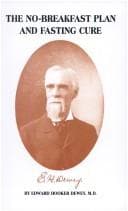
The No Breakfast Plan and the Fasting-CureDewey, Edward Hooker
Science
The No Breakfast Plan and the Fasting-Cure
Dewey, Edward Hooker
Fasting; Nutrition
I am happy to assure all readers that in all the involuntary fasts of my
cases of acute sickness or in the voluntary fasts in chronic disease,
has there been any other than improved general health as the result.
Notably was this the case in a man who fasted ten years ago for forty
days for an ulcer of the stomach, and who had been troubled with
indigestion for more than forty years. He had become nearly a mental and
physical wreck when he took to his bed with an abolished appetite. There
have since been some ten years of nearly perfect health, and now in his
seventy-seventh year he is the youngest-looking man for his age I have
ever seen. He walks the streets with the gait of a youth of twenty. To
do without food without hunger does not tax any vital power, as Dr.
Shrady may yet become aware.
XII.
The next fast to have a brief notoriety as the "most remarkable on
record" occurred in Philadelphia, the medical center of America, and
beneath the very shadow of its great medical schools; in Philadelphia, a
city that surpasses all other cities for the wisest conservatism, for
all-around level-headedness. Its journals are rarely equalled for their
clean, winnowed columns; there is no "yellow" journalism in that great,
fair city, known as the "Quaker City."
Miss Estella Kuenzel, a lady of twenty-two years, of acutest, finest
sensibilities, born to live in June and not in March, lost her mental
health to a degree that death became the final object of desire.
She had a friend in a bright young man of the name of Henry Ritter,
chemist and photographer at the Drexel Institute, a born scientist, and
who possesses the very genius of the pains and persistence of science.
Well versed in the science of the morning fast, he believed that a fast
which would merely end with hunger would result in all-around
improvement. A fast was instituted which he thought would not last more
than a few days, but went on until the days merged into weeks: it went
on because only general improvement attended it.
I first heard of it in a letter written by him on the thirty-eighth day
of the fast, during which there had been a walk of seven miles. On the
forty-second day of the fast I had a brief letter from Miss K., in which
every line was radiant with cheer.
At the Asylum five feedings per day were ordered, and at first were
rejected; but finally she accepted them as a means to end her unhappy
life; took them in bed, and in the last weeks seemed to be fleshing up,
as there was a gain of seventeen pounds above the normal, of water--she
had become dropsical. The last professional expert in her case advised a
half-gallon of milk daily in addition to the three regular meals--making
a five-meal plan.
To carry out an unopposed fast it was necessary to take her to a home
where the parents would be ignorant of this radical means to a cure.
The following is from Mr. Ritter's letters:
Public-domain text, read in full here on John Shaqi.
Reviews
Reviews
No reviews yet
Be the first to share your thoughts on this work.
Elsewhere in the archive
Join the Discussion
Join the discussion
Sign in to leave a comment or review.
Sign InorCreate an account