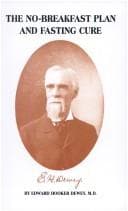
The No Breakfast Plan and the Fasting-CureDewey, Edward Hooker
Science
The No Breakfast Plan and the Fasting-Cure
Dewey, Edward Hooker
Fasting; Nutrition
The feeding is all done not at the time of hunger, but at the time of
day. All patients are expected to eat no less than three meals a day,
regardless of any desire for food and whether the patient spends all his
time in bed in mindless apathy, whether pacing his room with meaningless
tread, whether active in light service in the building or in heavy labor
without. When there is refusal to eat it seems to be taken for granted
that suicide by starvation is the design, and the pumping of food into
the stomach through the nose is the common resort. There seems to be no
thought that there may be no hunger in such cases, and no apprehension
of any danger from not eating; that in this they follow the instincts of
brutes. Would the desire for food not come and with a saner condition of
mind if they were permitted their own ways of eating?
A physically strong woman, whom I knew well, was sent to a hospital for
the insane in a generally bad state of mind, with destructive
propensities marked. With no desire for food, and certainly with no mind
to realize the need to eat without hunger, she naturally refused to
eat. But for a time her meals were forced down her throat, a proceeding
that taxed the strength of several strong arms.
Why were the meals not omitted long enough to cause such a reduction of
strength as to make feeding less expensive in the outlay of others'
muscle? The persistent refusal to eat resulted in a cessation of all
efforts to enforce food; left to the gentler hands of Nature for a time,
the mental hurricane subsided in great degree on the return of hunger,
and long before there was an appreciable loss of weight or strength. In
a few months this woman was able to return to her home, and with
restored mind to tell me of the violent feedings she had endured.
Now let us look again to the structural conditions involved in diseases
of the mind. There are those soft, pulpy centres from which emanate the
highest powers of life: power to think, to admire, to rejoice, or to
suffer; and we know how digestive power varies along the scale between
ecstacy and despair. In mental disease there is the same abnormal
structural change as in other local diseases; but for these sick
mind-centres there is no rest. There must be still thinking and feeling,
no matter how chaotic, to tax them, and there is no cheer to electrify
the stomach into easy display of power. We may well marvel that powers
so wonderful as the power to think, love, admire, see, hear, and feel
are located in structures so fragile as the brain; and we may well
marvel at the provision of the turret of flinty hardness to protect it
from violence.
Public-domain text, read in full here on John Shaqi.
Reviews
Reviews
No reviews yet
Be the first to share your thoughts on this work.
Elsewhere in the archive
Join the Discussion
Join the discussion
Sign in to leave a comment or review.
Sign InorCreate an account