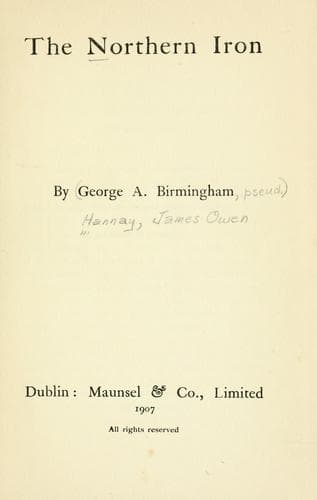
Historical fiction; Ireland -- History -- Rebellion of 1798 -- Fiction
A silence followed Donald Ward’s words. In 1798 talk of death in battle
or death on a scaffold moved even the youngest and most careless to
serious thought. The world was full then of the kind of ideas for which
men are well content to die, for the sake of which also they did not
hesitate to shed blood. The Americans had set mankind a headline to copy
in their Declaration of Independence. The French wrote Liberty with huge
red flourishes which set the heart of Europe beating high. Italians
were proclaiming a foreign army the liberators of their country, while
Jacobins growled fiercely against the Pope. Kosciusko, in Poland,
organised a futile revolution, and fell in the cause of national
freedom. Even phlegmatic Englishmen caught the spirit of the times,
hated intensely or worshipped enthusiastically that liberty which some
saw as an imperial goddess for the sake of whose bare limbs and pale,
noble face death might be gladly met; while others beheld in her
a blood-spattered strumpet whirling in abandoned dance round
gallows-altars which reeked with human sacrifice.
Ireland in those days was intellectually and spiritually alive. Men were
quick to feel the influence of world-wide ideas, and in Ireland the love
of liberty glowed brightly; nowhere more brightly than among the farmers
and lower middle classes of the north-eastern counties. The position was
a strange one. The landed gentry, who themselves, a few years before,
claimed and won from England the independence of their Parliament, grew
frightened and drew back from the path of reform on which alone
lay security for what they had got. The wealthier merchants and
manufacturers, satisfied with the trade freedom which brought them
prosperity, were averse to further change. The Presbyterians and the
lower classes generally were eager to press forward. They had conceived
the idea of a real Irish nation, of Gael and Gall united, of Churchman,
Roman Catholic and Dissenter working together for their country’s good
under a free constitution. But it soon became apparent that the reforms
they demanded would not be won by peaceful means. The natural terror of
the classes whose ascendancy or prosperity seemed to be threatened, the
bribes and cajoleries of British statesmen, turned the hearts of those
who ought to have been leaders from Ireland to England. The relentless
logic, the clear-sighted grasp of the inevitable trend of events,
and the restless energy of men like Wolfe Tone, changed a party of
constitutional reformers into a society of determined revolutionaries.
Threats of repression were answered by the formation of secret
societies. Acts of tyranny, condoned or approved by terror-stricken
magistrates, were silently endured by men filled with a grim hope that
the day of reckoning was near at hand. Far-seeing English statesmen
hoped to fish out of the troubled waters an act of national surrender
from the Irish Parliament, and were not ill-pleased to see the sky
grow darker.
Public-domain text, read in full here on John Shaqi.
Reviews
Reviews
No reviews yet
Be the first to share your thoughts on this work.
Join the Discussion
Join the discussion
Sign in to leave a comment or review.
Sign InorCreate an account