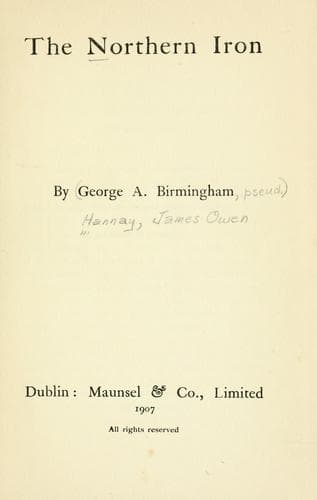
Historical fiction; Ireland -- History -- Rebellion of 1798 -- Fiction
Mistress Hannah Macaulay was a competent cook and housekeeper. It is
noticeable that women with sharp tongues are generally more efficient
than their gentler sisters. Solomon, who knew a good many things, seems
also to have known this. He was of opinion that a peaceful dinner of
herbs is better than a stalled ox and contention therewith. He knew that
he could not have both. It is the shrew who succeeds in giving the males
dependent on her stalled oxen and such like dainties to eat.
The caressing wife and the sweet-tempered cook accomplish no more
than dinners of herbs, and generally even they are not particularly
appetising. The fact is, that the management of domestic affairs is
the most trying of all occupations. Cooking, washing, cleaning, and
generally doing for men in a house means continuous irritation and
worry. A woman, however sweet-natured originally, who is condemned to
such work must either lose her temper over it, in which case she
may cook stalled oxen, but will certainly serve them with sauce of
contention, or she may give up the struggle and preserve her gentleness.
Then she will accomplish no more than dinners of herbs, boiled cabbages,
from which tepid water exudes, and dishes of pallid turnips, supposed
to be mashed but full of lumps. Solomon preferred, or said he preferred,
kisses and cauliflowers. On questions of taste there is no use
disputing.
Mistress Hannah Macaulay’s salmon steaks came to the table with an
appetising steam rising from their dish. Her slices of fried ham formed
an attractive nest for the white-skinned poached eggs. She had plates of
curly oatcake and powdery farles. She had yellow butter in saucers. She
brought the porridge to table in well-scoured wooden bowls with horn
spoons in them.
“The stirabout is good,” she said. “I thought you’d like to sup them
before you ate the meat.”
Neal poured the wine into an old cut-glass decanter, and set Maconchy’s
bottle of whisky, distilled, no doubt, by Maconchy himself among the
Rathlin Hills, beside his father’s plate.
Micah Ward said a long grace, in which he thanked the Almighty for the
fish, the ham, the eggs, the porridge, and his brother’s return from
America. As a kind of supplement, he added a prayer for the peace of
his household, in which Hannah Macaulay, appropriately enough under the
circumstances, was especially named.
After supper the two brothers drew their chairs to the fire. It was late
in May, but the air was still chilly in the evenings. Hannah took down
from the mantel-piece two well-polished brass candlesticks, fitted them
with tall dipt candles, and set them on the table she had cleared of
plates and dishes. Donald took a tobacco-box from his pocket, and filled
a pipe.
“Neal,” said his father, “you may go to your own room and complete the
transcription of the passages of Josephus which you left unfinished this
morning.”
“Let the lad stay,” said Donald.
Public-domain text, read in full here on John Shaqi.
Reviews
Reviews
No reviews yet
Be the first to share your thoughts on this work.
Join the Discussion
Join the discussion
Sign in to leave a comment or review.
Sign InorCreate an account