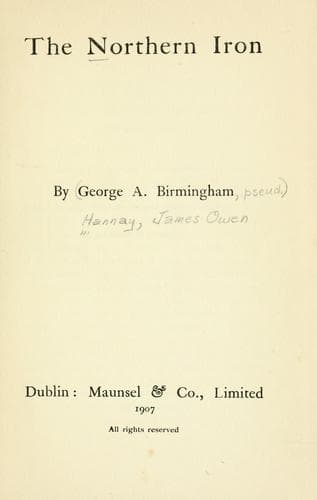
Historical fiction; Ireland -- History -- Rebellion of 1798 -- Fiction
“I do not choose,” said Lord Dunseveric, “to take part in the arrest of
a man who may be regarded as my personal enemy. You may tell your father
this, and you may tell him further that if he is a wise man he will
leave the country at once. The next magistrate charged with his arrest
may not have my scruples or my reasons for hesitating. Now, listen to
me, Neal, before I leave you, and mark what I say. I admit, and I always
have admitted, the justice of the claims which your people make. There
ought to be equality, full and complete, for you and the Catholics.
There ought to be an end to the tyranny under which you suffer, but
you are going the wrong way about getting your wrongs righted. Your
rebellion, if there is to be a rebellion, can’t succeed. You will be
crushed. And Neal, lad, that crushing will be an evil business. It will
be evil for you and your friends, but that’s not all. It will be made an
excuse for taking away the hard won liberty of Ireland. Keep out of
it, Neal. Take my advice, and keep out of it, for your own sake and for
Ireland’s.”
He took the young man’s hand, wrung it, and then turned and left the
room. Neal stood for a while dazed and bewildered. He had known before
that his father was a supporter of the United Irishmen. He had guessed,
though until that morning he had not actually known, how deeply he was
versed in the secrets of the society. He had never imagined that the
doings and sayings of an obscure Presbyterian minister were being
watched and noted by Government spies. He found it hard to realise that
the eyes of remote authorities, of secretaries of state, of generals of
armies, were fixed on the wind-swept, desolate, northern parish, on
the gaunt, grey manse he called his home. Yet the evidence of this
incredible surveillance was plain and unmistakable. Men of his father’s
congregation, men whom he supposed he knew personally, were to be
seized and marched off, to be flogged perhaps as others had been, to be
imprisoned certainly, to be hanged very likely, in the end. His father
was a marked man, with the choice before him of exile or imprisonment,
perhaps death. He himself was suspected, had been informed against, lied
about, by someone. His mind flew back to the list of names he had copied
out that morning, to the one name which had arrested his attention
especially. He remembered that James Finlay owed him a grudge, desired
revenge; he felt sure that James Finlay was the informer. Others might
have betrayed the secrets of the society. James Finlay alone, so far as
he could recollect, had any motive for incriminating him, an entirely
innocent man.
Public-domain text, read in full here on John Shaqi.
Reviews
Reviews
No reviews yet
Be the first to share your thoughts on this work.
Join the Discussion
Join the discussion
Sign in to leave a comment or review.
Sign InorCreate an account