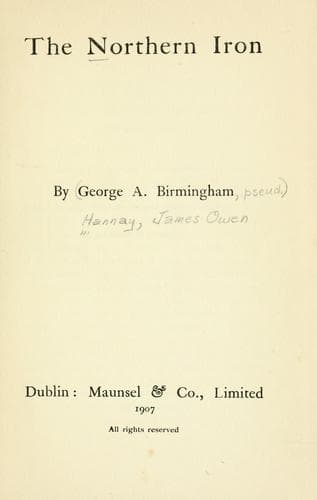
Historical fiction; Ireland -- History -- Rebellion of 1798 -- Fiction
To Neal the appearance of the man was not very interesting. He watched
him in mere idleness while waiting for the girl to bring the supper
Donald had ordered. If there had been anyone else in the room Neal would
not have wasted a second glance on the unobtrusive stranger. Yet, as
he watched the man he became aware of something about him which was
attractive. There was a dignity in his movements quite different from
Donald Ward’s habitual self-assertion, different, too, from the stately
confidence of Lord Dunseveric. There was a quiet seriousness in the
way he set to work at his writing, and a methodical carefulness in his
sorting of the scraps of paper which he drew one by one from his pocket.
The maid entered with the wine and food which Donald had ordered.
“You’ll be for beds, the night,” she said.
“Ay,” said Donald, “and do you see that the feathers are well shaken
and the beds soft. If you’d ridden all the miles I’ve ridden to-day,
my girl, after not being on the back of a horse for three months, you’d
want a soft bed to lie on.”
The stranger looked up from his notebook. There was laughter in his
dark eyes, but it went no further than his eyes. His lips showed no
inclination to smile.
Another man entered the room--a burly, strong man. He wore top boots,
as if he had been riding. He looked like a well-to-do farmer. He gave no
order to the girl, but walked straight to where the dark-eyed stranger
sat. Greetings passed between them, and then talk in a low voice. Both
of them looked at Donald and Neal. Then, beckoning to the girl, the
stranger asked if he could be accommodated with a private room. The girl
nodded, and went to prepare one. Donald Ward finished his supper, rose,
stretched himself, yawned, and then drawing a stool near the fire, sat
down and filled his pipe. Neal, interested to watch the evening street
traffic in a strange town, climbed on to the deep sill of the window and
pushed the lattice open. A blind piper sat on a stone bench outside the
inn and played a reel for some boys and girls who danced on the road. A
horseman--a handsomely-dressed man and well mounted--rode slowly up the
street towards Lord Massereene’s demesne. One of the dancers crossed
his way and caused the horse to shy. The rider cut at the girl with his
whip. An angry growl followed the retreating figure. The piper stopped
playing for a minute and listened. His face wore that eager look of
strained attention which is seen often on the faces of the blind. He
began to play again, and this time his tune was the “Ça Ira.” It was
well-known to his audience and its significance was understood. Several
voices began to hum it in unison with the pipes. More voices joined,
and in a minute or two the little crowd was shouting the tune. A grave,
elderly man, in the dark dress and white bands of a clergyman, stepped
out of a house opposite the inn and approached the piper. The dancers
and the onlookers stopped singing and saluted him respectfully. He spoke
Public-domain text, read in full here on John Shaqi.
Reviews
Reviews
No reviews yet
Be the first to share your thoughts on this work.
Join the Discussion
Join the discussion
Sign in to leave a comment or review.
Sign InorCreate an account