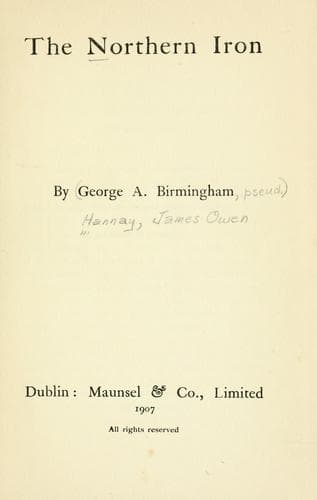
Historical fiction; Ireland -- History -- Rebellion of 1798 -- Fiction
Donald left the tap-room quickly. The street door closed, and in the
passage he found himself face to face with the gentle-mannered traveller
whom he had accosted in the street.
“I think,” said Donald, “that I have the honour of addressing Mr. Hope.”
“James Hope,” said the other, “or Jemmy Hope. I am but a weaver, a
simple man. I take no pride in the titles men give each other.”
“James Hope,” said Donald, “I’ve heard of you, and I’ve heard of you as
an honest man. I reckon there’s no title higher than that one. I think,
sir, that you have a room at your disposal in this house. May I speak
with you there? I have matters of some importance.”
James Hope turned without a word and led the way upstairs to a small
room. Three candles stood on the table. There were also tumblers and
an empty whisky bottle. It was noticeable that there were only two
tumblers. James Hope had not been drinking. Donald walked over to the
table and blew out one of the candles.
“I’m not more superstitious than other men,” he said, “but I won’t sit
in the room with three candles burning. It’s damned unlucky.”
Again, as earlier in the public room, Neal thought that James Hope was
going to laugh. But again the laughter got no further than his eyes.
“Now,” said Donald, “if you’ve no objection, I’ll have a fresh bottle on
the table and some clean glasses. You know this inn, James Hope, what’s
their best drink?”
“I have but a poor head,” said Hope. “I drink nothing but water. But I
believe that the whisky is good enough.”
“Neal, my boy,” said Donald, “the wench that bought us our supper is
gone to bed, and the landlord’s too drunk to carry anything upstairs.
You go and fill the jug there with hot water in the kitchen, and I’ll
get some whisky from the taproom.”
Donald filled himself a glass with a generous proportion of spirit, and
lit his pipe again.
“I’ve a letter here, addressed to you,” he said.
He fumbled in his breast pocket, drew forth a leather case, and took
from it one of the letters which Micah Ward had written. James Hope read
it carefully.
“You are,” he said, “the Donald Ward mentioned in this letter, and you
are Neal Ward, the son of a man whom we all respect and admire. I bid
you welcome.”
He held out his hand, first to Donald, who shook it heartily, and then
to Neal. He fixed his dark eyes on the young man’s face, and looked long
and steadily at him. Neal’s eyes wavered and dropped before this earnest
scrutiny, which seemed to read his very thoughts.
“God bless you and keep you, my boy,” said James Hope. “You are the son
of a brave man. I doubt not that you will be a brave man, too, brave in
a good cause.”
Donald Ward seemed a little impatient at this long scrutiny of Neal and
the speech which followed. He took several gulps of whisky and water and
blew clouds of tobacco smoke. He cleared his throat noisily and said.
“You’ll be satisfied, James Hope, by the letter I’ve given you that we
are men to be trusted?”
Public-domain text, read in full here on John Shaqi.
Reviews
Reviews
No reviews yet
Be the first to share your thoughts on this work.
Join the Discussion
Join the discussion
Sign in to leave a comment or review.
Sign InorCreate an account