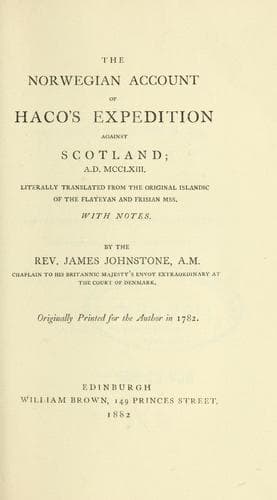
The Norwegian account of Haco's expedition against Scotland, A.D. MCCLXIII. — John Shaqi
The Norwegian account of Haco's expedition against Scotland, A.D. MCCLXIII.Sturla Þórðarson
History
The Norwegian account of Haco's expedition against Scotland, A.D. MCCLXIII.
Sturla Þórðarson
Haakon IV Haakonsson, King of Norway, 1204-1263; Norway -- History -- 1030-1397; Scandinavians; Scotland -- History -- To 1603
The situation of the Kings of the Isles was peculiarly delicate; for,
though their territories were extensive, yet they were by no means a
match for the neighbouring states. On this account, allegiance was
extorted from them by different Sovereigns. The Hebridian Princes
considered this involuntary homage, as, at least, implying protection:
and, when that was not afforded, they thought themselves justified in
forming new connexions more conducive to their safety.
The Alexanders of Scotland having united Galloway, then a powerful
maritime state, to their dominions, began to think of measures for
obtaining a permanent possession of the Hebrides by expelling the
Norwegians. The preparatory steps they took were first to secure the
Somerled family, and next to gain over the insular chieftains. Haco
was no less earnest to attach every person of consequence to his
party. He gave his daughter in marriage to Harold King of Man; and, on
different occasions, entertained at his court King John, Gilchrist,
Dugall the son of Rudri, Magnus Earl of Orkney, Simon bishop of the
Sudoreys, and the abbot of Icolmkil.
All this, however, did not effectually conciliate the Somerlidian
tribe. The Norwegian Monarch, disappointed in his negotiations, had
recourse to the sword, and sailed with a fleet, which both the
Sturlunga-saga, and the Flateyan annals represent as the most
formidable that ever left the ports of Norway.
It would be improper for the editor to draw any comparison between the
Scottish and Norwegian narratives; he, therefore, leaves it to the
discernment of the reader to fix what medium he thinks reasonable.
The Flateyan and Frisian are the principal MSS. now extant, that
contain the life of Haco the aged. The first belongs to the library of
His Danish Majesty, the latter is deposited in the Magnaean collection.
Of them the editor obtained copies; and by the help of the one was
enabled, reciprocally, to supply the imperfections of the other. He
has since examined the originals themselves.
The Fr. MS. relates the following anecdote of Missel, at the
coronation of Prince Magnus A.D. 1261. During Mass Missel the Knight
stood up in the middle of the Choir, and wondered greatly at some
ceremonies, unusual at the coronation of Scottish Kings. And when King
Magnus was robed, and King Haco and the Archbishop touched him with
the sword of state, the Scottish knight said, "It was told me, that
there were no knights dubbed in this land; but I never beheld any
knight created with so much solemnity as him whom ten (f. two) noble
lords have now invested with the Sword."
The conjectures, in my note on page 42 are confirmed by the following
passage in the Fl. MS. Then came there from the western seas John the
son of Duncan, and Dugall the son of Rudra; and both of them solicited
that King Haco would give them the title of King over the northern
part of the Sudoreys. They were with the King all summer.
Public-domain text, read in full here on John Shaqi.
Reviews
Reviews
No reviews yet
Be the first to share your thoughts on this work.
Join the Discussion
Join the discussion
Sign in to leave a comment or review.
Sign InorCreate an account