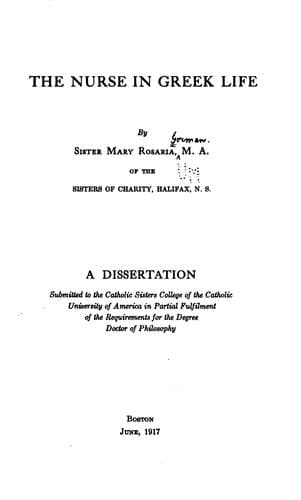
Greek literature -- History and criticism; Nurses; Thesis (Ph. D.)
Plato speaks of a method nurses had of finding out what children want.
When anything is brought to an infant and he is silent, then he is
supposed to be pleased, but when he weeps and cries out, then he is not
pleased.[149] Aristotle thinks that the crying of infants should not be
restrained since it is conducive to their growth: συμφέρουσι γὰρ πρὸς
αὔξησιν,[150] but Plutarch in his De Cohibenda Ira says: ὅπερ οὖν αἱ
τίτθαι πρὸς τὰ παιδία λέγουσι “μὴ κλαῖε καὶ λήψῃ” τοῦτο πρὸς τὸν θυμὸν
οὐκ ἀχρήστως.[151] By means of amulets and charms the nurses sedulously
guarded the children against the pernicious influence of witchcraft and
the evil eye. Demeter, in the Homeric Hymn, promises the mother that no
harm shall come to the child from witchcraft:
θρέψω, κοὔ μιν ἔολπα κακοφραδίῃσι τιθήνης
οὔτ’ ἄρ’ ἐπηλυσίη δηλήσεται οὔθ’ ὑποτάμνον.[152]
The amulets were usually of a grotesque character that the sight being
diverted to them should not make so strong an impression on the
child.[153] On the approach of a stranger, a nurse in charge of a
sleeping infant would spit towards him as if to keep off from the child
a possibly evil influence.[154] Another charm against the evil eye is
preserved by St. John Chrysostom: βόρβορον αἱ γυναῖκες ἐν τῷ βαλανείῳ
λαμβάνουσαι τροφοὶ καὶ θεραπαινίδες καὶ τῷ δακτύλῳ χρίσασαι κατὰ τοῦ
πετώπου τυποῦσι τοῦ παιδίου κἂν ἔρηταί τις, τί βούλεται ὁ βόρβορος τὶ δὲ
ὁ πηλός; ὀφθαλμὸν πονηρὸν ἀναστρέφει, φασί, καὶ βασκανίαν καὶ
φθόνον.[155]
At what age the children left the care of the nurses is not certain.
Chrysippus allows three years to them,[156] and according to Plato, the
boys and girls were separated at six.[157] It seems clear that the boys,
at least, were sent early to school to keep them out of harm’s way: ἐπεὶ
καὶ αἱ τίτθαι τοιάδε λέγουσι περὶ τῶν παιδίων ὡς ἀπιτέον αὐτοῖς ἐς
διδασκάλου. καὶ γὰρ ἂν μηδέπω μαθεῖν ἀγαθόν τι δύνωνται, ἀλλ’ οὖν φαῦλον
οὐδὲν ποιήσουσιν ἐκεῖ μένοντες.[158]
_The Nurse and the Grown Daughter_
The tie between nurse and child might continue strong in later years.
She often remained in the family as the attendant and sometimes as the
confidante of the young maiden. Thus Nausicaa’s old nurse lights her
fire and prepares her evening meal:
ἥ οἱ πῦρ ἀνέκαιε καὶ εἴσω δόρπον ἐκόσμει.[159]
The same nurse who had tended Phaedra as an infant remained in her
service until the death of her mistress. Her devotion, introduced mainly
as a dramatic expedient, is nevertheless lifelike. Indeed it is the
blindness, even to precipitancy, of her love of Phaedra which must be
held accountable for the method employed by her to cure the distemper of
her mistress. This she herself acknowledges in her answer to Phaedra:
ἔθρεψά σ’ εὔνους τ’ εἰμί· τῆς νόσου δέ σοι
ζητοῦσα φάρμαχ’ ηὗρον οὐχ ἁβουλόμην.
εἰ δ’ εὔ γ’ ἔπραξα, κάρτ’ ἂν ἐν σοφοῖσιν ἦ·
πρὸς τὰς τύχας γὰρ τὰς φρένας κεκτήμεθα.[160]
Public-domain text, read in full here on John Shaqi.
Reviews
Reviews
No reviews yet
Be the first to share your thoughts on this work.
Join the Discussion
Join the discussion
Sign in to leave a comment or review.
Sign InorCreate an account