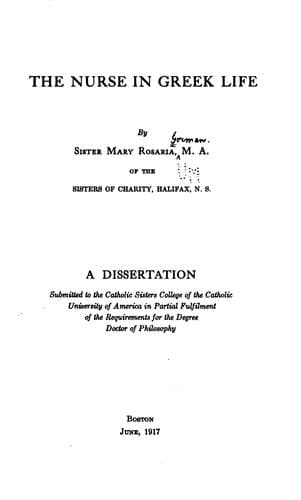
Greek literature -- History and criticism; Nurses; Thesis (Ph. D.)
The importance of the nurse in Greek life may be judged from the fact
that to her as well as to the mother was entrusted the early education
of the child. Quintilian quoting Chrysippus, whose treatise on Greek
education has unfortunately been lost, says: “Those advise better who
like Chrysippus think that no part of a child’s life should be exempt
from education. For Chrysippus, though he has allowed three years to the
nurses, yet is of the opinion that the minds of children may be imbued
with excellent instruction even by them.”[213] The same author wishes
nurses to be women of some knowledge. At any rate, they should be the
best circumstances allow.[214] If we can judge from Republic, 343 _a_,
the nurse taught the children to distinguish between ordinary words:
εἰπέ μοι, ἔφη, ὦ Σώκρατες, τίτθη σοι ἔστιν;... ὅτι τοί σε, ἔφη,
κορυζῶντα περιορᾷ καὶ οὐκ ἀπομύττει δεόμενον, ὅς γε αὐτῇ οὐδὲ πρόβατα
οὐδὲ ποιμένα γιγνώσκεις.
The first lessons of the nurse were imparted by means of stories and
songs, when children were not of an age to learn gymnastic. Of this
Plato makes mention in the following passage: οὐ μανθάνεις, ἦν δ’ ἐγώ,
ὅτι πρῶτον τοῖς παιδίοις μύθοις λεγόμενον; τοῦτο δέ που ὡς τὸ ὅλον
εἰπεῖν ψεῦδος, ἔνι δὲ καὶ ἀληθῆ. πρότερον δὲ μύθοις πρὸς τὰ παιδία ἢ
γυμνασίοις χρώμεθα.[215] Furthermore, he would have mothers and nurses
mould the minds of the children by means of these tales: πείσομεν τὰς
τροφούς τε καὶ μητέρας πλάττειν τὰς ψυχὰς αὐτῶν τοῖς μύθοις πόλυ μᾶλλον
ἢ τὰ σώματα ταῖς χερσίν.[216]
In ancient literature, however, we find only isolated traces of nursery
tales which may perhaps be accounted for by the contempt with which the
Greeks regarded this form of literature, an inference drawn from
Socrates’ answer to Hippias: σοι χαίρουσιν οἱ Λακεδαιμόνιοι, ἅτε πολλὰ
εἰδότι· καὶ χρῶνται ὥσπερ ταῖς πρεσβύτισιν οἱ παῖδες πρὸς τὸ ἡδέως
μυθολογῆσαι.[217] More emphatic is his answer to Gorgias: τάχα δ’ οὖν
ταῦτα μῦθος σοι δοκεῖ λέγεσθαι, ὥσπερ γραός· καὶ καταφρονεῖς αὐτῶν.[218]
In a similar strain writes Lucian: ἔτι σοι γραῶν μῦθοι τὰ λεγόμενα
ἐστι.[219] Disconnected as are the allusion to nursery tales and
notwithstanding the contempt in which they were held, we have sufficient
evidence to prove their existence and suggest their character.
Nurses had many ways of acting on the imaginations of their young
charges in order to secure their obedience, to quiet them or put them in
good humor. The choice of the tales depended on the nurse and on the
intelligence of the children whom they nursed διὰ μυθολογίας,[220] and
quieted again by tales after they had beaten them: καθάπερ αἱ τίτθαι τὰ
παιδία, ἐπειδὰν αὐτοῖς πληγὰς ἐμβάλωσι παραμυθούμεναι καὶ χαριζόμεναι
μῦθον αὐτοῖς ὕστερον διηγήσαντο.[221] This recounting of tales is also
mentioned by Philostratus: καὶ καταμυθολόγει με ἡ τίτθη χαριέντως.[222]
Public-domain text, read in full here on John Shaqi.
Reviews
Reviews
No reviews yet
Be the first to share your thoughts on this work.
Join the Discussion
Join the discussion
Sign in to leave a comment or review.
Sign InorCreate an account