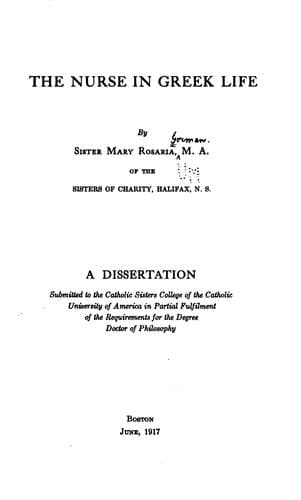
Greek literature -- History and criticism; Nurses; Thesis (Ph. D.)
Com. on Il., vi, p. 513.
Footnote 10:
Oppian, Halieutica. II, 404–5.
Footnote 11:
Brugmann, Grundriss der vergleichenden Grammatik, Strassburg, 1889,
ii, S. 92.
Footnote 12:
Lexicon, s. v. τροφοί.
Footnote 13:
Od., xxiii, 171. Cf. xxiii, 35, 81, 11; xix, 482, 500, etc.
Footnote 14:
Homeric Hymn Dem., 147.
Footnote 15:
Euripides, Hipp., 243.
Footnote 16:
Il., xxii, 82. Cf. also xvi, 203 and Od., xi, 448.
Footnote 17:
Od., xix, 482.
Footnote 18:
_Ibid._, xi, 448.
NOTE.—Seymour (Life in the Homeric Age, N. Y., 1914, p. 139), objects
to this on the ground that “nothing indicates that she (Eurycleia)
ever bore a child and could have served as a wet-nurse.” The words
εὐνῇ δ’ οὔ ποτ’ ἔμικτο (Od. I, 433) merely show that Eurycleia was not
the concubine of Laertes, and not that she was childless. Dolius, the
slave, had a wife and family in the household of Laertes (Od. xxiv,
389). Moreover, if the apportioning of awards mentioned in Od., xxi,
214 (ἄξομαι ἀμφοτέροις ἀλόχους) were a matter of custom, would not the
faithful Eurycleia have served as a very special prize? Cf. Buchholz,
Die Hom. Realien, Leipzig, 1881, vol. II, Pt. 2, p. 24.
Footnote 19:
Od., vii, 9.
Footnote 20:
_Ibid._, i, 430. Cf. also xv, 428.
Footnote 21:
Il., 389.
Footnote 22:
Od., xv, 427–444.
Footnote 23:
_Ibid._, xxii, 421.
Footnote 24:
_Ibid._, ii, 345.
Footnote 25:
_Ibid._, xxiii, 24.
Footnote 26:
Od., vii, 10.
Footnote 27:
_Ibid._, xx, 1–4.
Footnote 28:
Hom., Hymn to Dem., 141ff.
Footnote 29:
Hom., 166ff.
Footnote 30:
Hom., Hymn to Aphrod., 113ff.
Footnote 31:
Herodotus, vi, 61.
Footnote 32:
Euripides, Medea, 49.
Footnote 33:
Aeschylus, Cho., 750; Eur., Hipp., 698.
Footnote 34:
Eur., Hipp., 649.; And., 812.
Footnote 35:
_Ibid._, Med., 49.
Footnote 36:
_Ibid._, Med., 65: μή, πρὸς γενείου, κρύπτε σύνδουλον, σέθεν.
Footnote 37:
Hipp., 324.
Footnote 38:
Med., 54.
Footnote 39:
Troades, 195ff.
Footnote 40:
Dem., lvii, 42.
Footnote 41:
_Ibid._, lvii, 35.
Footnote 42:
_Ibid._, xlvii, 35ff.
Footnote 43:
Plato, Laws, 790A.
Footnote 44:
Samia, 21ff.
Footnote 45:
Capps, Four Plays of Menander, Boston, 1910, pp. 15, 239.
Footnote 46:
C. I. A., ii, 2729.
Footnote 47:
ἐλακωνομάνουν ἅπαντες ἄνθρωποι τότε.
Footnote 48:
Aristoph., Lys. 80–1. Cf. also Xen., Rep. Lac., I, 4.
Footnote 49:
Lyc., 16.
Footnote 50:
Alc., 1.
Footnote 51:
C. I. A., ii., 3111.
Footnote 52:
C. I. A., ii, 3097.
Footnote 53:
Epigram liv.
Footnote 54:
Theocritus, _Ibid._, ii, 70.
Footnote 55:
Theocritus, Epigram xx.
Footnote 56:
Pseudo-Plutarch, De Liberis Educandis, § 5.
Footnote 57:
_Ibid._
Footnote 58:
Apollonius Rhodius, iv, 1309–10.
Footnote 59:
Public-domain text, read in full here on John Shaqi.
Reviews
Reviews
No reviews yet
Be the first to share your thoughts on this work.
Join the Discussion
Join the discussion
Sign in to leave a comment or review.
Sign InorCreate an account