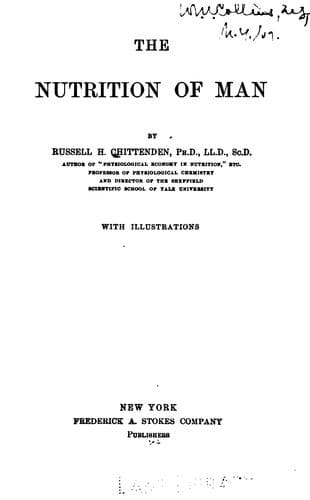
The nutrition of manChittenden, R. H. (Russell Henry)
Science
The nutrition of man
Chittenden, R. H. (Russell Henry)
Nutrition
transformation into any form of carbohydrate; or, if transformation
does occur, under some conditions, it must take place within the muscle
and without loss of energy. The practical significance of these facts
is at once apparent, for if fat, in order to be available as a source
of muscle energy, must first undergo conversion into sugar, it would
be far more economical from a physiological standpoint to replace the
fat of the diet with carbohydrate in any attempt to provide suitable
nourishment for the working muscle. We may safely conclude, however,
that fat and carbohydrate, as previously suggested, are in reality both
capable of direct metabolism by the muscular tissue, and that each is
of value as a source of muscular energy in proportion to its heat of
combustion, yielding substantially the same proportion of its potential
energy in the form of mechanical work.
Regarding the utilization of proteid as a source of energy by the
muscle, there are many grounds for believing that here the body
has to deal with certain alterations, before the proteid can be
made available. We may indeed conjecture the transformation of a
non-nitrogenous portion of the proteid molecule into carbohydrate, as
a necessary step in its utilization for muscle work. It is certainly
true that in the ordinary katabolic processes, through which proteid
passes, there is a tendency for the nitrogen-containing portion to
be quickly split off and eliminated, leaving a carbonaceous residue
which may represent as much as 80 per cent of the total energy of the
original proteid. This so-called carbon moiety of the proteid molecule
is apparently much less rapidly oxidized than the nitrogenous portion,
and may indeed be temporarily stored in the body, in the form of fat or
carbohydrate.[49] We have very convincing proof that the carbohydrate
glycogen can be formed from proteid. Thus, the feeding of proteid to
warm-blooded animals may be accompanied by an accumulation of glycogen
in the liver. This is interpreted as meaning that in the cleavage
of proteid by digestion the various nitrogenous products formed are
somewhere, probably in the liver, still further acted upon; the
contained nitrogen with some of the carbon being converted into urea,
while the non-nitrogenous residue is transformed into glycogen, or
sugar. That some such change takes place, or, more specifically, that
carbohydrate does result from proteid is more strikingly shown in human
beings suffering with diabetes. In severe forms of this disease, all
carbohydrate food consumed is rapidly eliminated through the kidneys in
the form of sugar, the body having lost the power of burning sugar. If
such a person is placed upon a diet composed exclusively of proteid,
sugar still continues to be excreted, and there is observed a certain
definite relationship between the nitrogen output and the excretion of
sugar, thus implying that they have a common origin.
Public-domain text, read in full here on John Shaqi.
Reviews
Reviews
No reviews yet
Be the first to share your thoughts on this work.
Elsewhere in the archive
Join the Discussion
Join the discussion
Sign in to leave a comment or review.
Sign InorCreate an account