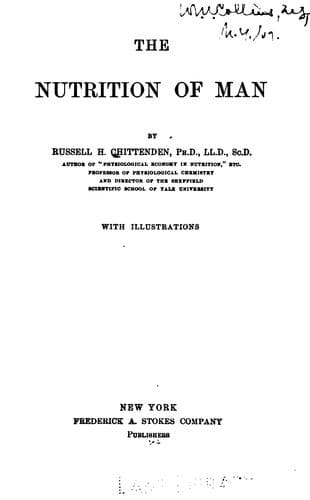
The nutrition of manChittenden, R. H. (Russell Henry)
Science
The nutrition of man
Chittenden, R. H. (Russell Henry)
Nutrition
[49] See Leo Langstein: Die Kohlehydratbildung aus Eiweiss.
Ergebnisse der Physiologie, Band 3, Erster Theil, p. 456.
See also, Lüthje: Zur Frage der Zuckerbildung aus Eiweiss. Archiv für
d. gesammte Physiologie, Band 106, p. 160.
Further, there are certain drugs, such as phloridzin, which, when
introduced into the circulation, set up a severe diabetes and
glycosuria. Dogs treated in this way, fed solely on proteid or even
starved for some time, will continue to excrete sugar, and as in the
previous instance, there is observed a certain definite ratio between
the nitrogen output and the elimination of sugar; thus leading to
the conclusion that both arise from the destruction of the proteid
molecule. Careful study of this ratio of dextrose to nitrogen has led
Lusk to the conclusion that full 58 per cent of the proteid may undergo
conversion into sugar in the body. Hence, it is easy to see how in
muscle work, when proteid is the sole source of the energy of muscular
contraction, the work accomplished may still result from the direct
oxidation of carbohydrate material, indirectly derived from the proteid
molecule. It requires no argument, however, to convince one that such a
procedure for the normal individual is less economical physiologically
than a direct utilization of carbohydrate and fat, introduced as such
and duly incorporated with the muscle substance. Consequently, in the
nourishment of the body for vigorous muscular work, there is reason
in a diet which shall provide an abundance of carbohydrate and fat;
proteid being added thereto only in amounts sufficient to meet the
ordinary requirements of the body for nitrogen and to furnish, it may
be, proper pabulum for the development of fresh muscle fibres, where,
as in training, effort is being made to strengthen the muscle tissue
and so enable it to do more work. Increase in proteid food may help to
make new tissue, but the source of the energy of muscle work is to be
found mainly in the breaking down of the non-nitrogenous materials,
carbohydrate and fat.
Public-domain text, read in full here on John Shaqi.
Reviews
Reviews
No reviews yet
Be the first to share your thoughts on this work.
Elsewhere in the archive
Join the Discussion
Join the discussion
Sign in to leave a comment or review.
Sign InorCreate an account