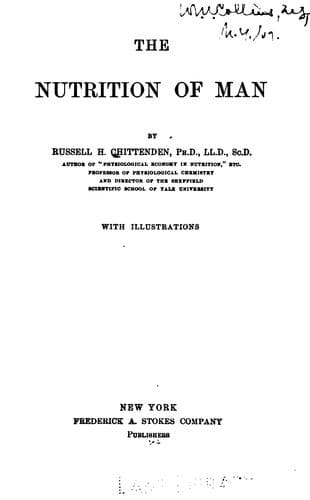
The nutrition of manChittenden, R. H. (Russell Henry)
Science
The nutrition of man
Chittenden, R. H. (Russell Henry)
Nutrition
In view of these facts, we may advantageously consider next the real
significance of the proteid metabolism of the body. As we have seen, a
meal rich in proteid leads at once--within a few hours--to an excretion
of urea equivalent to full 50 per cent of the nitrogen of the ingested
proteid, while a few hours later finds practically all of the nitrogen
of the intake eliminated from the body. Further, it is to be remembered
that in a general way this occurs no matter what the condition of the
body may be at the time and no matter how large or small the amount of
proteid consumed. In other words, there is practically no appreciable
storing of nitrogen or proteid for future needs,--at least none that is
proportional to the increase in nitrogen intake, even though the body
be in a condition approximating to nitrogen starvation. Moreover, it
is to be recalled that the increased proteid metabolism attendant on
increased intake of proteid food is accompanied by an acceleration of
the metabolism of non-nitrogenous matter; thus resulting in a stirring
up of tissue change, with consequent oxidation and loss of a certain
proportion of accumulated fat and carbohydrate. Coincident with this
increased excretion of nitrogen, the output of carbon dioxide is
likewise increased somewhat, due as is believed mainly to increased
metabolism of the involuntary muscle fibres of the gastro-intestinal
tract, by action of which the accelerated peristalsis so characteristic
of food intake is accomplished. Further, the increased output of
carbon dioxide, under these conditions, is to be attributed also to
the greater activity of the digestive and excretory organs, naturally
stimulated to greater functional power by the presence of proteid
foods and their decomposition products. Still, as stated by Leathes,
“the two main end-products of proteid metabolism, urea and carbonic
acid, are, to a great extent, produced independently of each other,
and the reactions which result in the discharge of the nitrogen are
not those in which energy is set free, work done, and carbonic acid
produced.” In other words, there is suggested what we have already
referred to, viz., that in proteid metabolism a nitrogenous portion of
the proteid molecule is quickly split off and gotten rid of, while the
non-nitrogenous part may be reserved for future oxidation, serving as
a source of muscle energy or for other purposes. This being so, it is
plain that “proteid metabolism in so far as it is concerned with the
evolution of energy, proteid metabolism in its exothermic stages, may
be almost entirely non-nitrogenous metabolism” (Leathes).
Public-domain text, read in full here on John Shaqi.
Reviews
Reviews
No reviews yet
Be the first to share your thoughts on this work.
Elsewhere in the archive
Join the Discussion
Join the discussion
Sign in to leave a comment or review.
Sign InorCreate an account