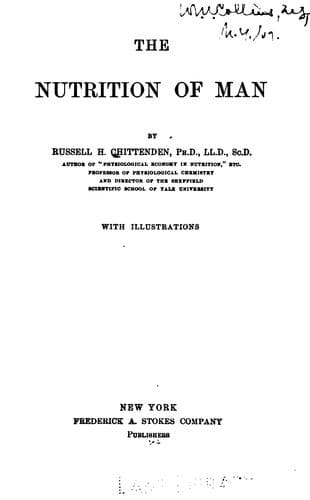
The nutrition of manChittenden, R. H. (Russell Henry)
Science
The nutrition of man
Chittenden, R. H. (Russell Henry)
Nutrition
In discussing these questions, we shall need to refer to several of
the current theories concerning proteid metabolism, notably, the
theories of Voit, Pflüger, and Folin. In 1867 Carl Voit,[50] of
Munich, advanced the view that the proteid material of the body exists
in two distinct forms, viz., as “morphotic” or “organized” proteid,
representing proteid which has actually become a part of the living
units of the body, _i. e._, an integral part of the living tissues;
and “circulating” proteid, or that which exists in the internal meshes
of the tissue, or in the surrounding lymph and circulating blood.
The real point of distinction here is that while one portion of the
body proteid is raised to the higher plane of living matter, _i. e._,
becomes a component part of the living protoplasm, another and perhaps
larger portion is outside of the morphological framework of the tissue,
constituting a sort of internal medium which bathes the living cells,
and acts as middleman between the blood and lymph on the one side and
the living cells on the other. According to Voit’s view, it is this
circulating proteid that undergoes metabolism; the proteid of the food
after digestion and absorption being carried to the different tissues
and organs, and then, without becoming an integral part of the living
protoplasm of the cells, it is broken down under the influence of
the latter. Obviously, small numbers of tissue cells are constantly
dying, their proteid matter passing into solution, where it likewise
undergoes metabolism. In other words, according to Voit, the great
bulk of the proteid undergoing katabolism is the circulating proteid,
derived more or less directly from the food, and which at no time has
been a part of the tissue framework; while a smaller, but more constant
amount, represents the breaking down of tissue cells. This conception
of proteid metabolism is akin to our conception of morphological and
physiological destruction. In the words of Foster: “We know that an
epithelial cell, as notably in the case of the skin, may be bodily
cast off and its place filled by a new cell; and probably a similar
disappearance of and renewal of histological units takes place in all
the tissues of the body to a variable extent. But in the adult body
these histological transformations are, in the cases of most of the
tissues, slow and infrequent. A muscle, for instance, may suffer very
considerable wasting and recover from that wasting without any loss or
renewal of its elementary fibres. And it is obvious that the metabolism
of which we are now speaking does not involve any such shifting of
histological units. On the other hand, we find these histological
units, the muscle fibre or the gland cell, for instance, living on
their internal medium, the blood, or rather on the lymph, which is
the middleman between themselves and the actual blood flowing in the
vascular channels.”
[50] See Voit: Hermann’s Handbuch der Physiologie, Band 6, p. 301.
Public-domain text, read in full here on John Shaqi.
Reviews
Reviews
No reviews yet
Be the first to share your thoughts on this work.
Elsewhere in the archive
Join the Discussion
Join the discussion
Sign in to leave a comment or review.
Sign InorCreate an account