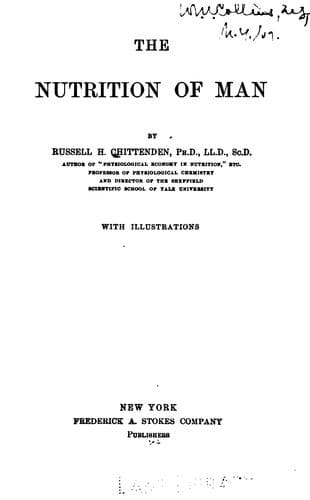
The nutrition of manChittenden, R. H. (Russell Henry)
Science
The nutrition of man
Chittenden, R. H. (Russell Henry)
Nutrition
In a fasting animal, the tissues and organs of the body still contain
a large proportion of proteid matter, yet only a small fraction of
this proteid is eliminated each day, hardly 1 per cent. If, however,
proteid is absorbed from the intestine, proteid metabolism is at once
increased, and the excretion of nitrogen may be fifteen times greater
than during hunger. In other words, the extent of proteid metabolism
is not at all proportional to the total amount of proteid contained
in the body as a whole, but runs parallel in a general way with the
quantity of proteid absorbed from the intestine. Obviously, the newly
absorbed proteid is quite different in nature from the proteid which
in much larger amounts is deposited throughout the body, since it is
not organized and is so much more easily decomposable (Voit). This is
the circulating proteid of the body; it exists in solution, and it is a
significant fact that, according to Voit, the chemical transformations
that characterize proteid katabolism occur only in solution. The
organized proteid, on the other hand, is in a state of suspension,
and its katabolism, which is relatively very small, is preceded by
solution of the proteid in the fluids of the tissue, after which
its further breaking down is assumed to be the same as that of the
circulating proteid. This latter view is a fundamental part of the Voit
theory; in long-continued fasting, for example, the living protoplasm
of the various tissues and organs is of necessity drawn upon for the
nourishment of the more vital parts of the body, such as the brain,
spinal cord, etc., consequently the organized proteid is gradually
dissolved and then decomposed, after it has become liquefied and has
thus lost its organized structure.
Public-domain text, read in full here on John Shaqi.
Reviews
Reviews
No reviews yet
Be the first to share your thoughts on this work.
Elsewhere in the archive
Join the Discussion
Join the discussion
Sign in to leave a comment or review.
Sign InorCreate an account