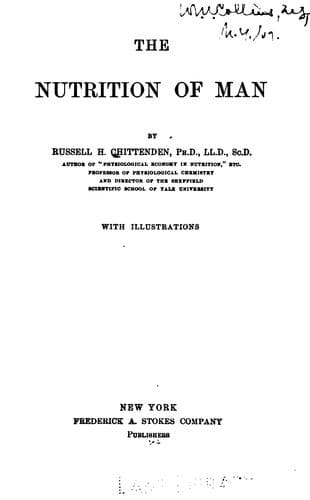
The nutrition of manChittenden, R. H. (Russell Henry)
Science
The nutrition of man
Chittenden, R. H. (Russell Henry)
Nutrition
but it seems possible, in the light of accumulating knowledge, that
our conceptions of the part played by proteid foods in the nutrition
of man have not been strictly logical, or quite in accord with true
physiological reasoning.
Again, in this connection, we may ask the question, why is it that the
body provides such an effective method for the speedy breaking down
of proteid food and the prompt elimination of the contained nitrogen?
Whatever the means made use of by the organism in accomplishing this,
the result is the same; the nitrogen of the ingested food is, in large
measure, quickly gotten rid of. We clearly recognize the all-important
position of proteid foods in the nutrition of the body, but there
appears a certain inconsistency in this prompt removal of the
nitrogen-containing portion of the proteid molecule. The nitrogenous
part of the proteid food is, physiologically considered, the
all-important part. It is the only source of nitrogen available to the
system, and yet apparently the larger proportion of this nitrogenous
material is not utilized in any recognizable way, but is eliminated as
quickly as possible. Is it not within the limits of possibility that
these methods, whatever may be the exact mechanism involved, are merely
a means of getting rid of a surplus of proteid for which the body has
no real need? This question I shall try to answer later on in another
connection, but we may advantageously keep this possibility in mind
while we are discussing these theories of proteid metabolism.
It is obvious, in the light of present knowledge, that there must
be a certain amount of true tissue proteid broken down each day,
independent of that larger metabolism coincident with the intake of
proteid food. However much this more voluminous proteid katabolism may
fluctuate, owing to variations in the intake of proteid, and whatever
the significance of this latter phase of metabolism, it is self-evident
that there must be a steady, constant metabolism, upon which the life
of the various tissues and organs of the body depends, and by which
the proteid integrity of the tissue cells is maintained. This implies
a certain degree of true tissue change, in which definite amounts of
proteid material are broken down and the resultant loss made good from
the proteid intake. No matter what specific name be applied to this
form of proteid katabolism, its existence is clearly recognized. It is
obviously a form of metabolism distinct, and probably quite different,
from that form, more variable in extent, which is associated with the
intake of proteid food. Plainly, if there is truth in these statements,
there should be some data available by means of which these two lines
of proteid katabolism can be more or less sharply differentiated.
Public-domain text, read in full here on John Shaqi.
Reviews
Reviews
No reviews yet
Be the first to share your thoughts on this work.
Elsewhere in the archive
Join the Discussion
Join the discussion
Sign in to leave a comment or review.
Sign InorCreate an account