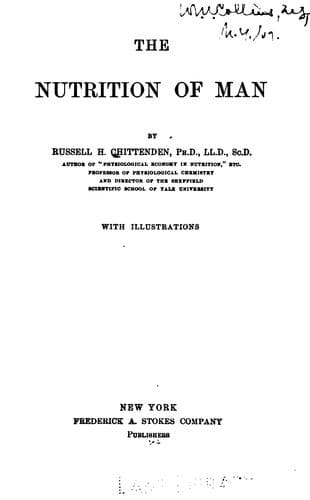
The nutrition of manChittenden, R. H. (Russell Henry)
Science
The nutrition of man
Chittenden, R. H. (Russell Henry)
Nutrition
As has been stated many times in the course of this presentation,
the most striking feature of proteid metabolism is the rapidity with
which large quantities of proteid consumed as food are broken down,
and the contained nitrogen eliminated from the body as urea. A few
hours will suffice to accomplish the more or less complete destruction
of food proteid; and any theory of proteid metabolism, to be at all
satisfactory, must explain this peculiar phenomenon. According to
recent investigations, it seems probable that some, at least, of the
cleavage products of proteid formed during intestinal digestion are
not built up into new proteid, but are at once eliminated mainly in
the form of urea, without becoming a part of either the so-called
circulating proteid, or the living protoplasm of the body. It will be
recalled that under the influence of the digestive enzymes, trypsin
and erepsin, proteid foodstuffs may be broken down while undergoing
intestinal digestion into monamino- and diamino-acids, such as
leucin, tyrosin, arginin, lysin, etc. A certain proportion of these
comparatively simple substances may be directly absorbed by the
portal circulation and carried to the liver, where they may undergo
conversion into urea. In this way, some portion of the nitrogen of
the ingested food may be quickly eliminated from the system. As has
been stated in another connection, we are not sure at present how
far proteid decomposition of the kind indicated takes place normally
in the body. We merely know that there are present in the intestine,
enzymes capable of splitting up proteid into these small fragments, and
that substances of this type when made to circulate through the liver
are transformed into urea. These facts, coupled with the well-known
tendency of the nitrogen of proteid food to appear in the excretions
a few hours after the food in question has been consumed, naturally
suggests a direct breaking down of proteid along the lines indicated,
with a possible retention of a carbonaceous residue (nitrogen-free)
for subsequent oxidation, as a source of energy for heat or work.
Obviously, all of the proteid food cannot behave in this manner, for
if such were the case there would be no proteid available for making
good the normal waste incidental to tissue changes. Either a certain
amount of proteid escapes this profound alteration produced by the
proteolytic enzymes in question, or else a certain proportion of these
simple decomposition products is synthesized in the intestine, or in
the tissues of the body, to form new proteid for the regeneration of
cell protoplasm. However this may be, we have presented in this view
a plausible explanation of the prompt appearance of food nitrogen in
the excretions, and without compelling belief in a theory, such as
Pflüger’s, which taxes one’s credulity to the utmost. To be sure,
as a prominent writer on physiology has recently said, such a view
stands opposed to our conceptions of the importance of proteid food;
Public-domain text, read in full here on John Shaqi.
Reviews
Reviews
No reviews yet
Be the first to share your thoughts on this work.
Elsewhere in the archive
Join the Discussion
Join the discussion
Sign in to leave a comment or review.
Sign InorCreate an account