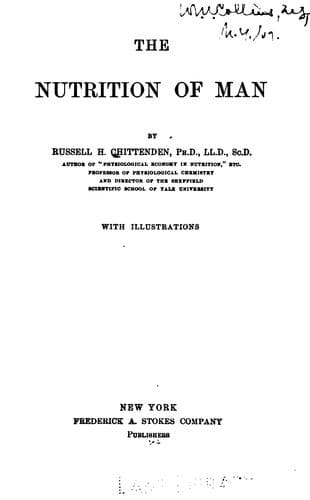
The nutrition of manChittenden, R. H. (Russell Henry)
Science
The nutrition of man
Chittenden, R. H. (Russell Henry)
Nutrition
Having acquired information regarding the principles of metabolism
and the general laws governing the nutrition of the body, we may
next consider briefly the dietetic habits of mankind, with a view
to learning how far such habits coincide with actual nutritive
requirements. Eventually, we shall need to ask the questions: What are
the _true_ nutritive requirements of the body? How much food and what
kinds of food does the ordinary individual doing an average amount
of work need each day in order to preserve body equilibrium, and to
maintain health, strength, and vigor under the varying conditions
of life? What amount of nitrogen or proteid, and what the total
calorific value required to supply the physiological needs of the
body? How closely do the so-called “normal diets” and “standard diets,”
which have met with such general acceptance, conform to a rational
conception of true physiological needs? These are vital questions of
great physiological and economic importance, and they are not easily
answered; but theoretical considerations based on scientific data, and
experimental evidence combined with practical experience, should point
the way to some very definite conclusions.
Observations made in many countries regarding the dietetic customs and
habits of the people have resulted in the establishment of certain
dietary standards, which have been more or less generally adopted
as representing the requirements of the body. As a prelude to the
discussion of this question, let us consider briefly some of the
results of these dietary studies. In Sweden, laborers doing hard work
were found by Hultgren and Landergren to consume daily, on an average,
189 grams of proteid, 714 grams of carbohydrate, and 110 grams of fat,
with a total fuel value for the day’s ration of 4726 large calories.
In Russia, workmen at moderately hard labor, having perfect freedom of
choice in their food, were found by Erisman to take daily 132 grams of
proteid, 584 grams of carbohydrate, and 79 grams of fat, this ration
having a fuel value of 3675 calories. In Germany, soldiers in active
service consumed daily, according to Voit, 145 grams of proteid, 500
grams of carbohydrate, and 100 grams of fat, with a fuel value of 3574
calories. In Italy, laborers doing a moderate amount of work were found
by Lichtenfelt to consume daily 115 grams of proteid, 696 grams of
carbohydrate, and 26 grams of fat, with a fuel value of 3655 calories.
In France, Gautier states that the ordinary laborer working eight
hours a day must have 135 grams of proteid, 700 grams of carbohydrate,
and 90 grams of fat daily, with a fuel value of 4260 calories. In
England, weavers were found to take daily 151 grams of proteid, with
carbohydrates and fats sufficient to make the total fuel value of the
day’s ration equal to 3475 calories. In Austria, farm laborers consumed
daily 159 grams of proteid, with carbohydrates and fats sufficient to
raise the fuel value of the food to 5096 calories.
Public-domain text, read in full here on John Shaqi.
Reviews
Reviews
No reviews yet
Be the first to share your thoughts on this work.
Elsewhere in the archive
Join the Discussion
Join the discussion
Sign in to leave a comment or review.
Sign InorCreate an account