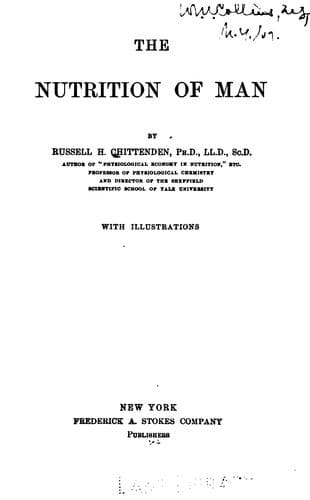
The nutrition of manChittenden, R. H. (Russell Henry)
Science
The nutrition of man
Chittenden, R. H. (Russell Henry)
Nutrition
The figures given in the preceding table under the head of American
subjects constitute the “Atwater standards,” and as already indicated,
are based upon the dietetic habits of over 15,000 persons under
different conditions of life and physical activity. In the words of
the official Bulletin, these standards covering the quantities of food
per day “are intended to show the actual food requirements of persons
under different conditions of life and work.” Here, however, lies an
assumption which seems to meet with wide acceptance, but for which it
is difficult to conceive any logical reason. The thousands of dietary
studies made on peoples all over the world, affording more or less
accurate information regarding the average amounts of proteid, fat,
and carbohydrate consumed under varying conditions, are indeed most
interesting and important, as affording information regarding dietetic
customs and habits; but, the writer fails to see any reason why such
data need be assumed to throw any light on the actual food requirements
of the body. In the words of another, “Food should be ingested in just
the proper amount to repair the waste of the body; to furnish it with
the energy it needs for work and warmth; to maintain it in vigor;
and, in the case of immature animals, to provide the proper excess
for normal growth, in order to be of the most advantage to the body”
(Benedict).
Any habitual excess of food, over and above what is really needed
to meet the actual wants of the body, is not only uneconomical, but
may be distinctly disadvantageous. Voit, among others, has clearly
emphasized the general principle that the smallest amount of proteid,
with non-nitrogenous food added, that will suffice to keep the body in
a state of continual vigor is the ideal diet. My own conception of the
true food requirements of the body has been expressed in the statement
that man needs of proteids, fats, and carbohydrates sufficient to
establish and maintain physiological and nitrogen equilibrium;
sufficient to keep up that strength of body and mind that is essential
to good health, to maintain the highest degree of physical and mental
activity with the smallest amount of friction and the least expenditure
of energy, and to preserve and heighten, if possible, the ordinary
resistance of the body to disease germs. The smallest amount of food
that will accomplish these ends is, I think, the ideal diet. There must
truly be enough to supply the real needs of the body, but any great
surplus over and above what is actually called for may in the long run
prove an undesirable addition. With these thoughts in mind, may we
not reasonably ask why it should be assumed that there is any tangible
connection between the dietetic habits of a people and their true
physiological needs?
Public-domain text, read in full here on John Shaqi.
Reviews
Reviews
No reviews yet
Be the first to share your thoughts on this work.
Elsewhere in the archive
Join the Discussion
Join the discussion
Sign in to leave a comment or review.
Sign InorCreate an account