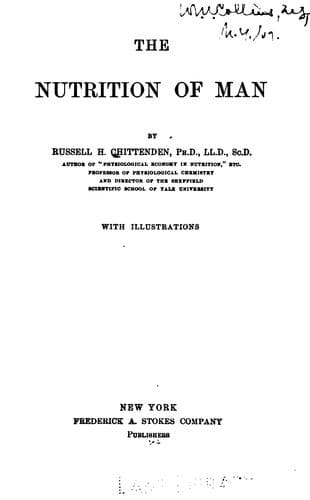
The nutrition of manChittenden, R. H. (Russell Henry)
Science
The nutrition of man
Chittenden, R. H. (Russell Henry)
Nutrition
But it may be asked, is not appetite a safe guide to follow? Do not
the cravings of the stomach and the so-called pangs of hunger merit
consideration? Is it not the part of wisdom to follow inclination in
the choice and quantity of our food? Can we not safely rely upon these
factors as an index of the real needs of the body? If these questions
are to be answered in the affirmative, then it is plain that a study
of dietetic customs will tell us definitely how much food and what
kinds of food are required daily to supply the true wants of the body.
There are writers who claim that instinct is a perfectly safe guide to
follow; that it is far superior to reason; but it is to be noticed
that most of these writers, if they have any physiological knowledge
to draw upon, are sooner or later prone to admit that the body has
certain definite needs which it is the purpose of food to supply, with
the added implication that any surplus of food over and above what is
necessary to meet these demands is entirely uncalled for. Thus, one
such writer states that “the man in the street follows his God-given
instincts and plods peacefully along to his three square meals a day,
consisting of anything he can find in the market, and just as much of
it as he can afford, with special preference for rich meats, fats, and
sugars.” Yet this same writer, a little later, emphasizes the fact that
“every particle of the energy which sparkles in our eyes, which moves
our muscles, which warms our imaginations, is sunlight cunningly woven
into our food by the living cell, whether vegetable or animal. Every
movement, every word, every thought, every aspiration represents the
expenditure of precisely so much energy derived from food.” Why, then,
would it not be wise to ascertain how much energy is so expended, on
an average, during the day’s activity and govern the intake of food
accordingly? Why not apply an intelligent supervision in place of
following an instinct which, in the words of the author just quoted,
leads one on to consume “anything he can find in the market and just as
much of it as he can afford”? Truly, if dietetic customs and the habits
of mankind are the results of instinct working in this fashion, there
cannot be much value in the data obtained by observing the quantities
of food mankind is in the habit of eating. Dietary standards based on
such observations must be open to the suspicion of representing values
far above the actual needs of the body.
Public-domain text, read in full here on John Shaqi.
Reviews
Reviews
No reviews yet
Be the first to share your thoughts on this work.
Elsewhere in the archive
Join the Discussion
Join the discussion
Sign in to leave a comment or review.
Sign InorCreate an account