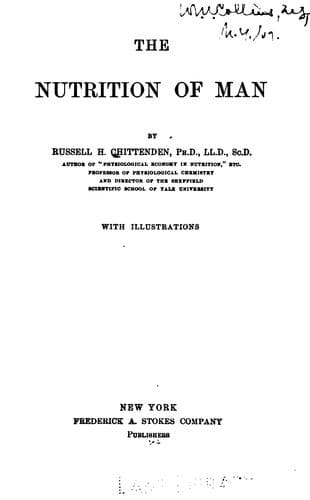
The nutrition of manChittenden, R. H. (Russell Henry)
Science
The nutrition of man
Chittenden, R. H. (Russell Henry)
Nutrition
Habits and cravings are certainly very unreliable indices of true
physiological requirements. Man is constantly acquiring new habits, and
these in time become second nature, forcing him to practise that which
he has become accustomed to, regardless of whether it is beneficial
or otherwise. The celebrated philosopher, John Locke, in his essay on
education, says: “I do not think all people’s appetites are alike ...
but this I think, that many are made gourmands and gluttons by custom,
that were not so by nature; and I see in some countries, men as lusty
and strong, that eat but two meals a day, as others that have set their
stomachs by a constant usage, like Larums, to call on them for four or
five.” Again, the so-called cravings of appetite are largely artificial
and mainly the result of habit. A habit once acquired and persistently
followed soon has us in its grasp, and then any deviation therefrom is
very apt to disturb our physiological equilibrium. The system makes
complaint, and we experience a craving, it may be, for that to which
the body has become accustomed. There has thus come about a sentiment
that the cravings of the appetite for food are to be fully satisfied,
that this is merely obedience to nature’s laws. In reality, there is
no foundation for such a belief; any one with a little persistence can
change his or her habits of life, change the whole order of cravings,
thereby indicating that the latter are essentially artificial, and that
they have no necessary connection with the welfare or needs of the
body. The man who for some reason deems it advisable to adopt two meals
a day in place of three or four, at first experiences a certain amount
of discomfort, but eventually the new habit becomes a part of the daily
routine, and the man’s life moves forward as before, with perfect
comfort and without a suggestion of craving, or a pang of hunger.
Dietetic requirements, and standard dietaries, are not to be founded
upon the so-called cravings of appetite and the instinctive demands
for food, but upon reason and intelligence, reinforced by definite
knowledge of the real necessities of the bodily machinery.
Public-domain text, read in full here on John Shaqi.
Reviews
Reviews
No reviews yet
Be the first to share your thoughts on this work.
Elsewhere in the archive
Join the Discussion
Join the discussion
Sign in to leave a comment or review.
Sign InorCreate an account