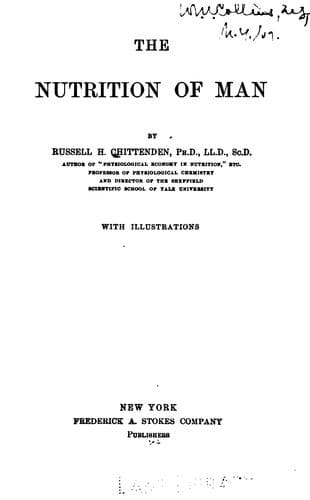
The nutrition of manChittenden, R. H. (Russell Henry)
Science
The nutrition of man
Chittenden, R. H. (Russell Henry)
Nutrition
Dinner.--Wheat popovers 57 grams, butter 10 grams, lettuce-orange
salad with mayonnaise dressing 147 grams, crackers 22 grams, cream
cheese 21 grams, cottage pudding 82 grams, coffee 48 grams, sugar 11
grams.
Total nitrogen content of the day’s food = 4.941 grams.
_June 27._
Breakfast.--Coffee 112 grams, cream 22 grams, sugar 10 grams.
Lunch.--Roast lamb 9 grams, baked potato 90 grams, wheat gems 47
grams, butter 12 grams, iced tea 250 grams, sugar 25 grams, vanilla
éclair 47 grams.
Dinner.--Lamb chop 32 grams, creamed potato 107 grams, asparagus 49
grams, bread 35 grams, butter 17 grams, lettuce-orange salad with
mayonnaise dressing 150 grams, crackers 21 grams, cream cheese 12
grams, coffee 63 grams, sugar 9 grams.
Total nitrogen content of the day’s food = 5.486 grams.
It can be seen that there was nothing especially peculiar in these
dietaries, aside from their simplicity, except that the quantities
were small. Meat was not excluded; there was no approach to a cereal
diet; there were no fads involved, nothing but simple moderation
in the amounts of nitrogen-containing foods. Further, there was
perfect freedom of choice; full latitude to consider personal likes
and dislikes in the selection of foods; anything that appealed to
the appetite could be eaten, with the simple restriction that the
amount taken must be small. During the balance days, naturally, every
article of food had to be carefully weighed and analyzed, which fact
undoubtedly tended to limit in some degree the variety of foods chosen,
since increase in the number of articles meant increased labor in
analysis. Quite noticeable, however, was the extreme constancy in the
nitrogen-content of the daily diet, even on those days when the food
was not weighed. In other words, there had been gradually acquired
a new habit of food consumption, and the individual, unconsciously
perhaps, rarely overstepped the limits fixed by the new level of
proteid metabolism. This is a fact that has been conspicuous in nearly
all of our experiments, where freedom of choice in the taking of food
has been followed; and is in harmony with the view that after a lower
level of proteid metabolism has once been established, and the body has
become accustomed to the new conditions, there is little tendency for
any marked deviation from the new standards of food consumption.
Public-domain text, read in full here on John Shaqi.
Reviews
Reviews
No reviews yet
Be the first to share your thoughts on this work.
Elsewhere in the archive
Join the Discussion
Join the discussion
Sign in to leave a comment or review.
Sign InorCreate an account